24 hr
Sharm El Sheikh to Cairo: Pyramids, Sphinx & Museum Day Trip
- Expert local guide
- Small group
- Skip-the-line access
- Free cancellation
Sharm El Sheikh to Pyramids — Giza Day Trips & Reserved Plateau Entry
From Red Sea coast to desert stone, four thousand years in one day.
Compare fares, pick the fit — all bookings are mobile-voucher and eligible for free cancellation where shown.
24 hr
18 hr
22 hr
Anyone planning sharm el sheikh to pyramids day trips has to make one decision before booking: general plateau access, or plateau access plus a paid interior climb. Both start from the same base ticket, but a skip-the-line Great Pyramid interior pass changes the whole visit.
| General Plateau Entry (Exterior views) |
Top pick Plateau + Khafre Interior (Burial chamber) |
Plateau + Great Pyramid Interior (Ascending passage) | |
|---|---|---|---|
| What it includes | Exterior of all 3 pyramids, Sphinx enclosure | Plateau entry plus Khafre's inner chamber | Plateau entry plus Khufu's inner passages |
| Interior access | — | ✓ Khafre only | ✓ Great Pyramid only |
| Typical add-on cost tier | None — base 700 EGP fee | Low tier (roughly +100–300 EGP) | Highest tier (roughly +400–1,500 EGP) |
| Who should buy it | Sightseers, photographers, tight schedules | First-timers wanting one interior without extra strain | History-focused visitors set on Khufu's chamber |
| Availability/limits | None — always open during hours | Sold at gate, more consistently available | Capped daily allotment, sells out in peak season |
| Best for | Budget-minded, limited-mobility visitors | Most first-time visitors | Bucket-list travelers, early bookers |
| See tickets & prices |
Verdict: Most first-timers on a sharm el sheikh to pyramids tour should add the Khafre interior for a manageable taste of the inside, and reserve the Great Pyramid ticket only if climbing Khufu's passages is a non-negotiable goal.
Worth it once, not for a relaxed trip
The sharm el sheikh to pyramids run is a long haul: expect a full day of travel bookending a few hours on the Giza plateau. The 700 EGP general entry buys you access to the plateau itself, letting you walk up to the Great Pyramid, the Sphinx, and the surrounding Old Kingdom necropolis. That fee is modest; the real cost is the transfer distance from the Red Sea coast, which flights shorten and road transfers stretch across a demanding day. Weigh it honestly. For a first-timer who may never return to Egypt, standing beside a genuine Wonder of the Ancient World justifies the effort, and organised sharm el sheikh to pyramids tours fold the logistics into one price. For a diver on a short beach holiday, the travel time erodes value fast. Booking sharm el sheikh to pyramids tickets alongside a flight, not a coach, keeps the day sane.
Bottom line: Book a flight-based sharm el sheikh to pyramids tour and it pays off; attempt it by coach on a short holiday and it rarely does.
Hand-picked experiences loved by thousands of travelers
2 days
Free Cancellation
Discover Cairo's ancient wonders on a 2-day excursion featuring a luxury pyramid-view stay and a visit to the Grand Egyptian Museum.
20 hours
Free Cancellation
Discover Cairo's ancient wonders on this full-day adventure featuring iconic pyramids, historic museums, and a scenic Nile cruise.
12 hours
Free Cancellation
Fly to Cairo for a private full-day tour of the Giza Pyramids, the Egyptian Museum, and the vibrant Khan El Khalili bazaar.
Pass security screening and buy general plateau admission at Al Haram Street gates
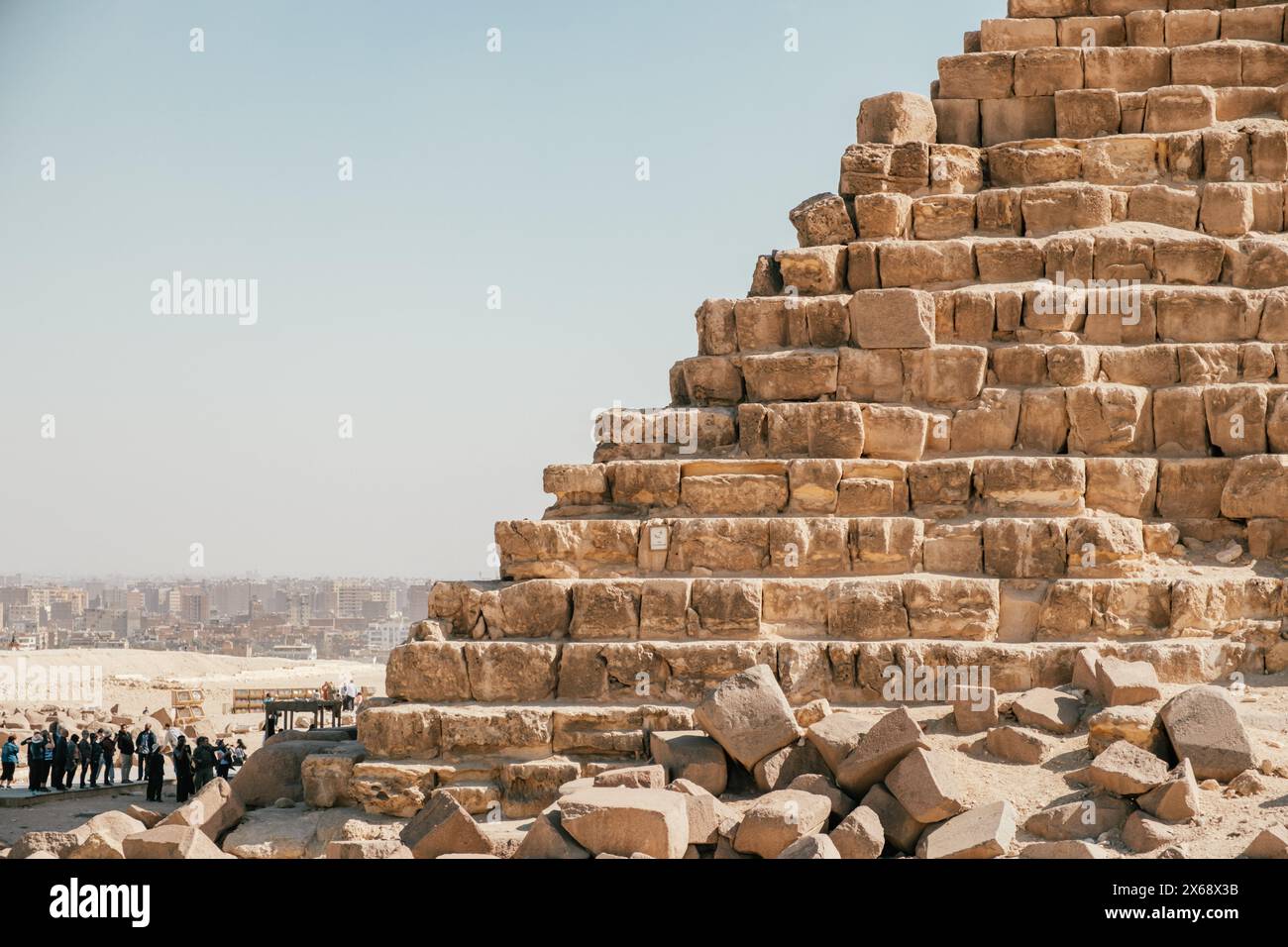
Walk the base of the largest pyramid and view the original casing stones
Approach the second pyramid, noting its surviving limestone cap
View the limestone monument from the main platform near Khafre's valley temple
Visit the smallest of the three main pyramids and its satellite structures
Photograph all three pyramids together from the elevated dune area south of the complex
Originally 147 meters tall and now standing at 138 meters after losing its outer limestone casing, this is the largest of the three main pyramids and the only surviving Wonder of the Ancient World. Its base spans 227 meters per side and its faces rise at a 51.8-degree angle.
Rising to 136 meters, this second pyramid sits on ground about 10 meters higher than Khufu's, an elevation trick that makes it appear taller from a distance. A section of its original polished limestone casing still survives near its summit.
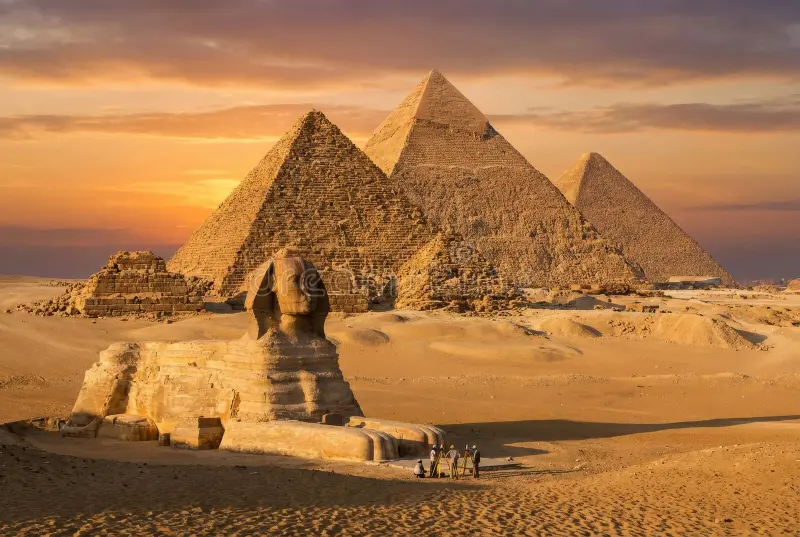
Carved directly from the plateau's natural limestone bedrock, this recumbent figure with a human head and lion's body measures about 74 meters long. It stands guard near Khafre's valley temple and remains one of the most debated monuments regarding its exact age.
The smallest of the three principal pyramids at roughly 61-65 meters tall, it was left unfinished at Menkaure's death and completed by his son Shepseskaf. Its lower courses were originally clad in red granite rather than limestone.
Home to a 43-meter cedar funerary vessel found dismantled into 1,224 pieces in a sealed pit beside the Great Pyramid in 1954. The boat was constructed without a single nail, using rope-lashing techniques over 4,500 years old.
Built from massive limestone blocks encased in polished granite, this is considered the best-preserved valley temple on the plateau. A long stone causeway once connected it directly to Khafre's mortuary temple at the pyramid's base.
You leave the Red Sea coast in darkness, and the Sinai desert unrolls flat and pale through the window until the Nile valley greens the horizon. By the time the plateau appears, the three silhouettes have already resolved from haze into hard geometry against the sky. You pass through general entry at Al Haram, Nazlet El-Semman, and the first thing that surprises you is scale. Standing at the base of Khufu's pyramid, you tilt your head back and the courses of stone climb past the point where your eye can follow them. You run a palm across a single block taller than your waist. Guides gather near the causeway; camels shift and grumble on the sand. You walk the perimeter toward Khafre, then down the slope to where the Sphinx faces east across the desert. From the viewing terrace the whole necropolis lines up — three pyramids, the lion, the modern city pressing at the edge of the enclosure. You stand at the panorama point where all three summits stack into one frame. A sharm el sheikh to pyramids tour usually leaves early to beat the desert heat, so by midday you are moving back toward the coach, dust on your shoes, the ruins receding in the mirror. You carry the quiet of the site with you the whole way home.
All the details about your upcoming adventure in one place
The journey from sharm el sheikh to pyramids covers roughly 500 kilometres of Sinai and desert road, connecting the Red Sea coast with the Giza plateau and its ancient necropolis. These sharm el sheikh to pyramids tours pair the great pyramid of Khufu and the Great Sphinx with the pharaonic heritage that draws travellers across Egypt. A guided Cairo pyramids excursion typically also weaves in nearby Giza landmarks, giving depth to a long but rewarding trip.
The Great Pyramid of Khufu held the record as the tallest structure built by human hands for nearly 3,800 years, until the spire of Lincoln Cathedral rose in England around 1311. That single fact frames the scale of what waits at the end of the road for anyone weighing a sharm el sheikh to pyramids journey: a monument older than the concept of Egypt as most travellers imagine it. The plateau at Giza holds three principal pyramids, raised for the Fourth Dynasty pharaohs Khufu, Khafre, and Menkaure across roughly the twenty-sixth century BCE. Khufu's is the largest, originally cased in polished Tura limestone that once returned the desert light like a mirror. Khafre's appears taller only because it stands on higher bedrock, and it alone retains a cap of that original casing near its summit. Menkaure's is the smallest of the trio, its lower courses sheathed in red Aswan granite hauled some 900 kilometres downriver. Guarding the eastern edge lies the Great Sphinx, a single mass of soft limestone carved into a recumbent lion with a human face, measuring 73 metres long and 20 metres high. For much of its history it stood buried to the shoulders in sand, and the paws were not fully excavated until the twentieth century. Why the site still matters is a question of continuity. These are the only survivors of the seven wonders catalogued by classical writers, and they remain in their original place, unmoved and unrebuilt. The necropolis around them — mastaba tombs, boat pits, the mortuary temples and their causeways — records an entire administrative civilisation organised around the afterlife of its kings. A dismantled cedar vessel found sealed beside Khufu's pyramid, now conserved rather than displayed at the plateau, shows the precision of that ambition. The engineering remains partly unresolved. Khufu's pyramid comprises an estimated 2.3 million blocks, some interior granite beams weighing upward of 50 tonnes, lifted and set with a tolerance modern surveyors still measure in centimetres. The internal architecture — the Grand Gallery, the ascending and descending passages, the King's Chamber with its stress-relieving vaults — reflects revisions made during construction rather than a single fixed plan. For the coastal traveller, a sharm el sheikh to pyramids tour compresses this weight of history into the span of a long day. It is why the Sharm El Sheikh Giza excursion endures on the region's itineraries, and why the broader draw of these Giza landmarks outlasts every passing fashion in travel. The stones say more in silence than any brochure, and a well-planned sharm el sheikh to pyramids tickets booking simply opens the door to them.
These are the only survivors of the seven classical wonders, and they remain in their original place, unmoved and unrebuilt.
Modest clothing is expected on the Giza Plateau: shoulders and knees covered is the safest standard, and closed-toe shoes help on the loose sand and stone. Many travelers on a sharm el sheikh to pyramids tour dress in lightweight, breathable fabrics given the exposed desert heat, with a hat and sunglasses recommended year-round.
A security checkpoint with metal detectors and bag scanners sits at the main entrance on Al Haram Street before ticket control. Backpacks and daypacks are permitted but may be opened for inspection, and drones are confiscated on site unless a separate permit has been arranged in advance.
Personal photography and video with handheld phones and cameras is free across the open plateau, including the Sphinx viewing area. Tripods and professional rigs require a separate paid permit from site management, and drone photography is prohibited without prior authorization from Egyptian authorities.
Children under 6 enter free, and the open plateau layout gives kids room to move, though the site has no playgrounds or shaded rest areas. Strollers struggle on the sandy terrain, so a baby carrier works better for younger children.
The plateau surface is uneven sand, gravel, and rock, which makes wheelchair and stroller access difficult beyond the paved areas near the main entrance and the Sphinx viewpoint. There are no ramps into the pyramid interiors, and travelers with mobility limitations are advised to arrange a golf-cart or camel/horse transfer at the gate rather than walking the full site.
No food stalls or restaurants operate inside the ticketed plateau, and bringing in outside food is limited to small snacks and sealed bottled water. Eating is generally confined to designated rest areas near the entrance and the Sphinx viewpoint rather than directly beside the monuments.
Quieter mornings, fewer bus groups
Later opening for prayers is common locally
Busiest day, weekend crowds
Opening hours
07:00 – 17:00 daily, last entry approx. 16:00
Address
Al Haram, Nazlet El-Semman, Giza, Egypt
Terrain
Uneven sand and rock paths, limited wheelchair routes
Climate
Hot, exposed desert plateau with little shade
Bag policy
Small bags allowed, large backpacks screened at gate
Layout
Open-air plateau spanning Khufu, Khafre and Menkaure pyramids
Car · 20-30 min from Cairo · Approx. 100-300 EGP taxi fare
Private transfer or taxi from central Cairo runs along the Cairo-Alexandria Desert Road or Faisal Street directly to the Giza Plateau entrance, with paid parking available near the gates
Public transport · 45-60 min from central Cairo · Metro fare plus short taxi hop
Cairo Metro Line 2 to Giza Station, then a local minibus or taxi covers the final stretch along Pyramids Road (Al Haram Street) to the plateau gates
Taxi · 20-40 min depending on traffic · Metered app fare
Ride-hailing apps such as Uber or Careem operate reliably between Cairo hotels and the Giza Plateau gate, with drop-off at the main security checkpoint
General plateau admission is a fixed 700 EGP ticket for foreign adults purchased at the gate and is non-refundable once issued. Third-party sharm el sheikh to pyramids tours booked through operators typically allow free cancellation 24-48 hours before the scheduled departure, with the entrance fee portion forfeited if cancelled later.
Weather · crowds · average price — dots go green to amber to red as each metric rises.
Cooler daytime temperatures around 20-25°C draw the largest crowds of the year, especially around the New Year holidays. Advance ticket booking is recommended for this peak season.
Mild weather and moderate crowds make March and April a balanced choice before summer heat sets in. Occasional khamsin sandstorms can reduce visibility in late spring.
Daytime temperatures regularly exceed 38°C, so early morning or late afternoon visits are strongly preferred. Crowds thin out considerably compared to winter, and many sharm el sheikh to pyramids tours shift departure times earlier to beat the heat.
Temperatures moderate into the low 30s°C and crowds stay lighter than winter. This shoulder season is often cited as a good compromise between comfort and cost.
Arriving between 07:00 and 09:00 keeps temperatures manageable and gets ahead of tour bus groups arriving mid-morning.
Agree on a fixed price in Egyptian pounds before mounting any camel or horse, since disputes over add-on fees are common near the Sphinx enclosure.
Card payment is standard for tickets, but small EGP notes help with tips for guides, restroom attendants, and photo assistance.
Closed-toe shoes handle the loose sand and rocky ground far better than sandals across the plateau's uneven terrain.
The museum sits a short walk from the Great Pyramid and adds under an hour to a standard sharm el sheikh to pyramids itinerary.
Great Pyramid interior access is limited daily and can sell out, so securing that ticket right after arrival improves the odds.
Wind-blown sand is common on the open plateau, so a protective case or bag for cameras and phones helps prevent damage.
Al Haram, Nazlet El-Semman, Giza, Egypt
Primary entry and ticket checkpoint for most sharm el sheikh to pyramids tours
Get directionsNear Khafre Valley Temple, Giza Plateau
Common group assembly point for guided tours after the Sphinx visit
Get directionsThe Giza plateau owes its skyline to the Fourth Dynasty, a burst of royal ambition around 2600 BCE. Khufu commissioned the first and largest structure. His architects raised roughly 2.3 million limestone blocks over an estimated two decades. The vizier Hemiunu is credited with overseeing the design. The Great Pyramid rose about 146.6 metres, holding the record for tallest human structure for nearly four millennia. Any visitor completing the sharm el sheikh to pyramids journey today confronts a monument older than written European history. Khufu's son Khafre followed with the second pyramid, built on higher bedrock so it appears taller than his father's. Beside it he set the Great Sphinx, its face long thought to bear his likeness. Menkaure raised the smallest of the three around 2510 BCE, casing its lower courses in red Aswan granite before the work was left unfinished at his death. Together these reigns fixed the plateau's form. Modern sharm el sheikh to pyramids tours retrace that same Fourth Dynasty sequence west to east. Engineering debate has never settled. Herodotus, visiting around 450 BCE, recorded that ramps hauled the stone, a claim scholars still contest against theories of internal spiral ramps and lever systems. In 1837 Howard Vyse used gunpowder to force entry into Menkaure's chamber, a destructive episode typical of early exploration. The 1925 discovery of Queen Hetepheres' tomb and the 1954 excavation of Khufu's dismantled cedar solar boat added evidence without ending the arguments. In 2017 the ScanPyramids project detected a large void within Khufu's structure using cosmic-ray muons. Of the seven wonders catalogued by ancient writers, only Giza endures. Earthquakes stripped much of the polished Tura limestone casing, later quarried for medieval Cairo, yet the cores stand. Those weighing sharm el sheikh to pyramids tickets are buying passage to the last surviving Ancient Wonder and a UNESCO World Heritage site. A guided sharm el sheikh to pyramids tour frames these Giza landmarks within the necropolis that has drawn travellers for over two thousand years.
Khufu commissioned the Great Pyramid, overseen by the vizier Hemiunu.
Khafre raised the second pyramid and set the Great Sphinx beside it.
Menkaure built the smallest pyramid, its granite casing left unfinished at his death.
Herodotus recorded ramp-based construction, sparking a debate still unresolved.
Howard Vyse used gunpowder to force entry into Menkaure's burial chamber.
Excavators uncovered Khufu's dismantled cedar solar boat near the south face.
The ScanPyramids team detected a large hidden void using cosmic-ray muons.
The classic viewpoint on the plateau's southwestern edge where all three pyramids line up in one frame against the open desert; many travelers arrange sharm el sheikh to pyramids day trips specifically to catch this shot before the site fills with tour groups. Park at the marked lot and walk a few paces onto the sand for the clearest alignment.
A raised platform beside the Great Sphinx gives the tight, classic angle of its profile with the Great Pyramid rising directly behind it, the shot most associated with Giza. Stand at the platform rail rather than the sandy forecourt for the cleanest sightline.
An open sand area facing the Sphinx works well for a full-body shot with the Sphinx and pyramids together in the background, and it empties out once most visitors move toward the pyramids. Stand back from the rope barrier for the widest composition.
A hillside café terrace on the plateau's edge overlooking all nine pyramids of the Giza necropolis in one uninterrupted desert panorama. Order a drink to sit at the outdoor Bedouin-style seating rather than just passing through.
Walking to the far corner of the Great Pyramid's base puts the structure's full scale in frame with no crowds and open desert behind it, a quieter alternative reached on foot from the main plaza. This angle also works for a near-solo shot against the stone blocks.
A sharm el sheikh to pyramids day trip is a long haul for young kids, so the real challenge is pacing them through sun, sand, and a very early flight or transfer rather than the plateau itself. With realistic breaks, most families manage it fine, and the payoff is watching kids stand next to something genuinely enormous.
The plateau is sandy, rocky, and uneven, so wheels get stuck fast. A soft-structured baby carrier works far better than a stroller for anyone under walking age.
Children under 4 tire quickly in the heat and open space, while kids 6 and up tend to engage more with the scale and stories of the site. Toddlers can still come, just keep expectations short.
The narrow, steep passageways inside the Great Pyramid are cramped and hot, and not recommended for young children or anyone prone to claustrophobia. Most families with kids skip the interior chambers and stay on the open plateau instead.
Arrive during the 07:00–09:00 window noted for this site to get cooler air before midday heat sets in. Pack hats, high-SPF sunscreen, and more water than feels necessary, since there is little shade anywhere on the plateau.
Break the visit into 45-60 minute chunks with water and shade stops, since attention spans and heat tolerance both drop fast in kids. Given the transfer time involved in any sharm el sheikh to pyramids tour, build slack into the schedule rather than a tight itinerary.
Paid restrooms exist near the ticket booth and the Solar Boat Museum area, but there are no baby-change stations, so bring a portable changing mat and extra wipes.
Most travelers on a sharm el sheikh to pyramids day trip lunch either on-plateau at Khufu's or afterward on a Nazlet El-Semman rooftop, since there's no proper visitor-center food court inside the gate itself — just scattered vendor stalls near the entrances.
Set inside the Giza Plateau with an unobstructed Great Pyramid view, reachable only via the Fayoum Gate shuttle; known for modern Egyptian set menus, gets fully booked by midday so arrive early or reserve ahead
Cushioned open-air seating among the smaller queens' pyramids, serving Egyptian classics and drinks from 8am to 5pm with last entry at 4pm, popular for a relaxed post-entry stop rather than a formal meal
Atop the Marvel Stone Hotel in Nazlet El-Semman, mixing Italian, Mediterranean and Egyptian plates with a panoramic pyramid backdrop, best booked for sunset when tables fill quickly
Inside the Great Pyramid Inn facing the Sphinx and pyramids, a casual pick for grilled meats and seafood pasta after finishing a sharm el sheikh to pyramids tour
Vendors near Nazlet El-Semman's approach roads sell koshary, ful medames and ta'ameya; pick busy stalls with fast turnover for a cheap, quick bite between sites.
Real experiences from real travelers
The sharm el sheikh to pyramids run is a serious drive, so we left before dawn and watched the sun come up over the desert on the way. By the time we reached the Giza plateau the light was hitting the limestone and the scale of the Great Pyramid was hard to process in person. Bring water and something for the heat.
Booked one of the sharm el sheikh to pyramids tours with a small group and it was well organized from pickup to drop-off. Standing next to the Sphinx with the Great Pyramid behind it was the highlight, and our guide knew the plateau layout well. The road hours are long but the flight option cuts it down.
As a local I have seen the Giza pyramids many times, but the desert light at golden hour still gets me every visit. The camels near the ridge were calm and the panorama of all three pyramids together is the shot everyone wants. Go early to beat the midday sun.
The Giza pyramids tour delivered on the landmarks, though the return leg felt endless after a full day walking the plateau. The Sphinx was smaller than I imagined and the pyramids far larger. Worth doing once for the Cairo landmarks alone.
We chose the flight version of the sharm el sheikh to pyramids tour to save time and still had the whole afternoon on the plateau. The wind carried fine sand and the blocks of the Great Pyramid tower over you up close. Our guide explained the necropolis layout clearly.
Riding a camel along the sand ridge below the pyramids at sunset was the moment I remember most. The heat was strong by midday so a hat and sunscreen are essential. The Giza plateau tour gave us time at both the pyramids and the Sphinx terrace.
If you can get the skip-the-line pyramids access do it, the queue for interior entry moved slowly in the sun. The sharm el sheikh to pyramids tickets we bought included transport and a guide which made the long journey easier. The Sphinx viewpoint was less crowded early morning.
Nothing prepared me for how enormous the limestone blocks are when you stand at the base. Our sharm el sheikh to pyramids tour had an early start but the empty plateau at first light was worth every minute. The desert panorama of the three pyramids stays with you.
We combined the Cairo landmarks with a stop at the Sphinx and the Giza plateau in one long day. The drive is real, so pick a comfortable coach or the short flight. Watching golden hour hit the ancient limestone made the whole trip.
The pyramids themselves are everything you hope for, but the sheer distance from the coast wore us out. Consider staying a night near Cairo if you want more time on the plateau. The Sphinx and the panorama of all three pyramids were the standout moments.
Everything you need to know for your journey
The Giza Plateau is open daily from 07:00 to 17:00, with last entry around 16:00, so most sharm el sheikh to pyramids tours plan a full-day window around those hours.
The plateau's sandy, uneven terrain limits wheelchair access beyond the paved zones near the entrance, so travelers with mobility needs often arrange a golf-cart transfer at the gate.
A security checkpoint with metal detectors sits at the main entrance, and large bags, drones without a permit, and glass bottles are among the items restricted on site.
Personal photography with phones and handheld cameras is free across the plateau, though tripods and professional filming equipment require a separate paid permit.
Arriving between 07:00 and 09:00 during the cooler winter months (December-February) offers the best balance of comfort and lighter crowds for sharm el sheikh to pyramids tickets.
Modest clothing covering shoulders and knees along with closed-toe shoes is recommended given the exposed, sandy terrain of the Giza Plateau.
Outside food is limited to small snacks and sealed water, since no restaurants operate inside the ticketed plateau area.
Sharm El Sheikh to Pyramids travel typically means a domestic flight to Cairo followed by a 20-30 minute drive or metro-and-taxi combination to the Giza Plateau gates.
Yes, children under 6 enter free and the open-air layout gives them space to explore, though strollers struggle on the sandy ground.
General admission tickets purchased at the gate are non-refundable, while many third-party sharm el sheikh to pyramids tours allow free cancellation 24-48 hours before departure.
The Great Sphinx, the Solar Boat Museum, and Khafre's Valley Temple all sit within a short walk of the main pyramids and pair naturally with a single-day visit.
The base 700 EGP general plateau ticket covers the exterior areas only; entry inside the Great Pyramid, Khafre, or Menkaure requires a separate additional ticket.
Houses the reconstructed cedar funerary boat of Khufu discovered sealed in a pit beside the Great Pyramid in 1954. The vessel measures roughly 43 meters long and was built entirely without nails.
A recumbent limestone figure with a human head and lion's body carved from the plateau's natural bedrock. It stands near the valley temple associated with Khafre.
A granite-clad structure connected to the Pyramid of Khafre by a long stone causeway. It is considered one of the best-preserved Old Kingdom temples on the plateau.
An elevated dune area south of the pyramid complex offering a classic wide-angle view of all three main pyramids together. It is a popular stop for camel and horse rides.
Hotels along Al Haram Street and Pyramids Road range from budget guesthouses to upscale properties, many advertising rooftop pyramid views.
A historic hotel set directly at the base of the plateau with gardens facing the Great Pyramid.
A wider range of mid-range hotels near Tahrir Square, convenient for combining pyramid visits with museum and Nile-side sightseeing.
Join thousands of happy travelers who have discovered this incredible experience
Book Your Experience Now