8 hr
Cairo: Pyramids, Sphinx, Saqqara & Memphis Full-Day Tour
- Expert local guide
- Small group
- Skip-the-line access
- Free cancellation
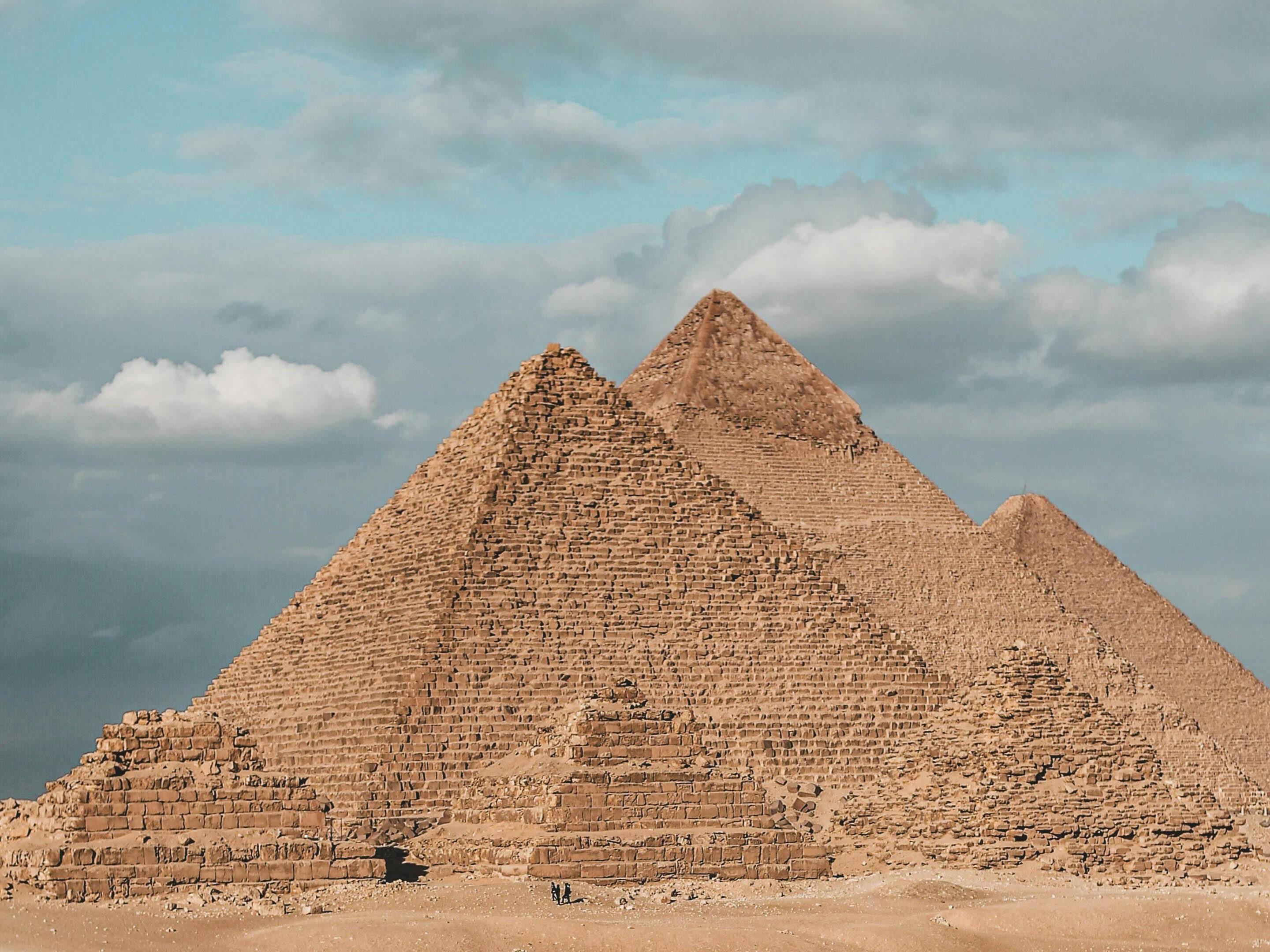
Saqqara And Memphis Tour — Reserved Entry to the Step Pyramid
Djoser's staircase to heaven, Memphis in fallen stone.
Compare fares, pick the fit — all bookings are mobile-voucher and eligible for free cancellation where shown.
8 hr
8 hr
8 hr
Worth it for history buffs and first-timers
A saqqara and memphis tour costs 600 EGP for site entry, and the value math favours most travellers. For that fee you walk right up to the Step Pyramid of Djoser, the world's oldest large-scale stone monument, plus the painted mastaba tombs and the open-air statuary at nearby Memphis. The payoff over Giza is space: thin crowds, room to photograph, and hieroglyph-lined burial chambers you can enter without a scrum. Factor in the drive from Cairo and you spend roughly half a day, so casual sightseers on a tight clock may find Giza alone enough. But for anyone drawn to Old Kingdom necropolis history, the Djoser complex and colossal Ramesses statue justify the ticket easily. This descriptive Cairo necropolis tour rewards curiosity more than a checklist. Skip-the-line Saqqara access and the calmer atmosphere make these saqqara and memphis tour tickets a sound spend for engaged visitors.
Bottom line: For Old Kingdom history lovers the saqqara and memphis tour is an easy yes; time-pressed first-timers can weigh it against a Giza-only day.
Most travelers who book a saqqara and memphis tour ask whether to bolt on Dahshur, and the honest answer is: add it only if you have a full day, since the Bent and Red Pyramids reward patience more than a quick stop.
|
Top pick Saqqara & Memphis |
Dahshur (Bent & Red Pyramids) | |
|---|---|---|
| What you see | Step Pyramid of Djoser, Memphis open-air museum | Bent Pyramid, Red Pyramid exteriors and interiors |
| Historical significance | Oldest stone monument, first capital ruins | Sneferu's transitional pyramids, precursors to Giza |
| Crowd levels | Moderate — regular tour bus traffic | Low — often near-empty, few vendors |
| Distance from Giza | On the same route, roughly 25–30 km | About 25–30 km south, 40 minutes further |
| Typical add-on cost | Included in most Saqqara-Memphis packages | Often 500–750 EGP added for a full-day combo |
| Time needed | 2–3 hours for both Saqqara and Memphis | 1.5–2 hours, plus travel time each way |
| See tickets & prices |
Verdict: Skip Dahshur if your day is limited to Saqqara-and-Memphis-tour pacing, but add it when you have a full day and want the Red Pyramid's interior climb without the Giza crowds.
Hand-picked experiences loved by thousands of travelers
6 hours
Free Cancellation
Uncover Egypt's architectural origins on this guided day trip to the ancient pyramid fields and the historic city of Memphis.
3 hours
Free Cancellation
Explore Egypt’s ancient capital and the iconic pyramids of Dahshur on this private, guided half-day excursion from Cairo.
6 hours
Free Cancellation
Discover the roots of pyramid building on this 6-hour private excursion to Sakkara, Dahshur, and the ruins of Memphis.
Begin at the museum near the Saqqara gate to see statues, sarcophagi, and tools before exploring the ruins outside
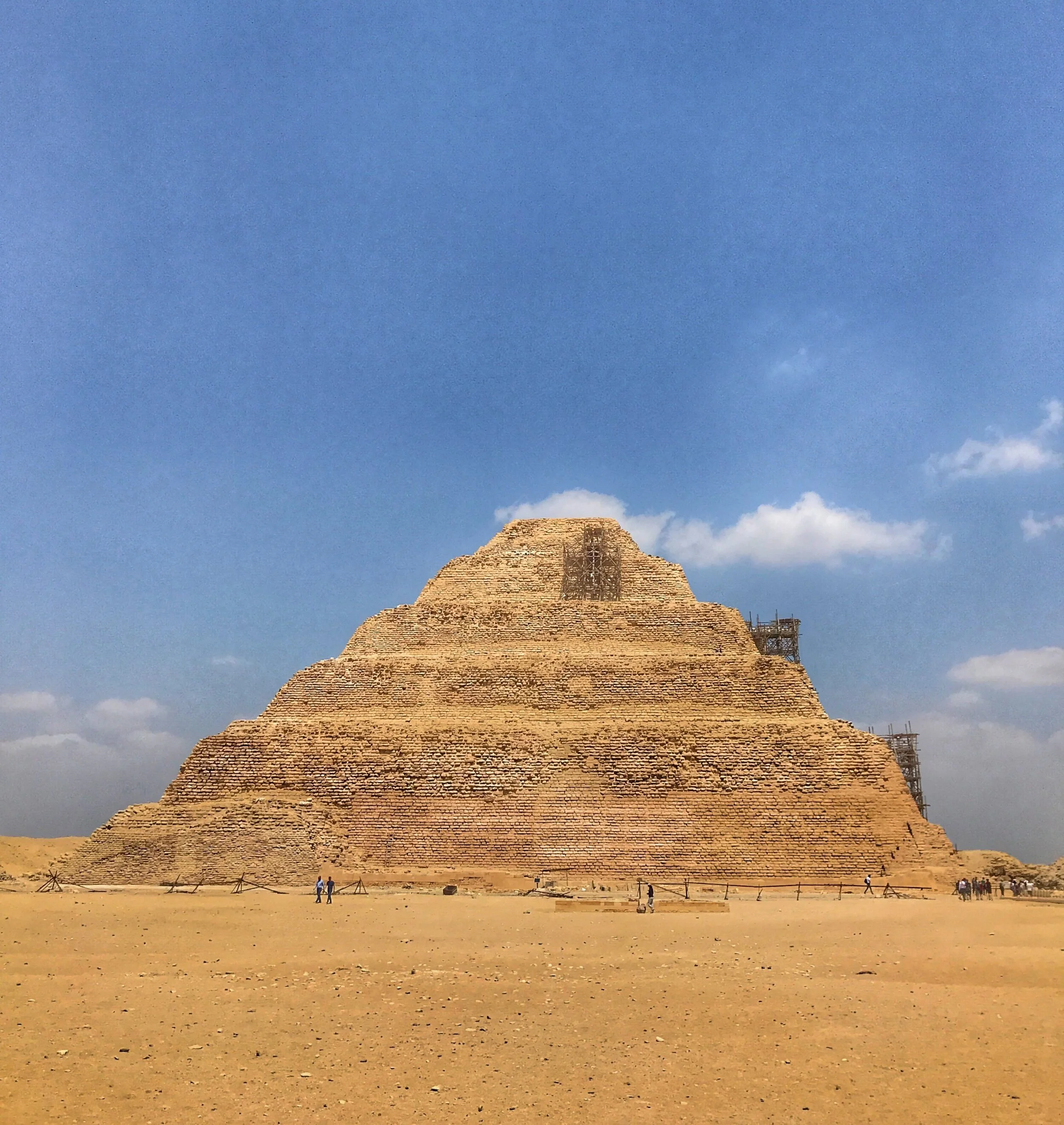
Walk the entrance colonnade with its 40 engaged columns, then cross the great south court to view the six-tiered Step Pyramid
Visit the Fifth Dynasty pyramid known for its painted Pyramid Texts inside the burial chamber
Descend into the underground catacombs built for the mummified Apis bulls
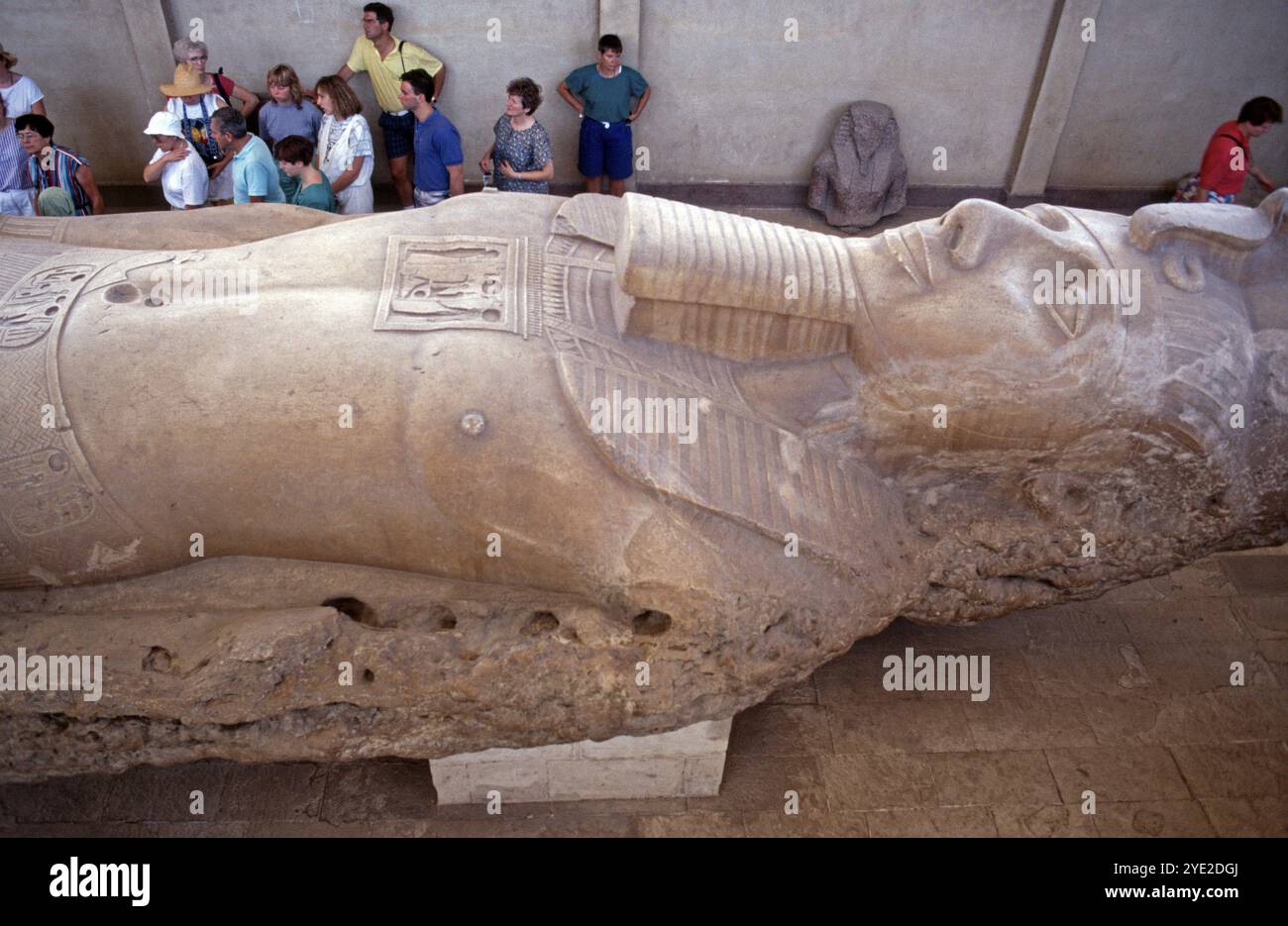
See the fallen Colossus of Ramesses II and the alabaster sphinx at the site of Egypt's ancient capital
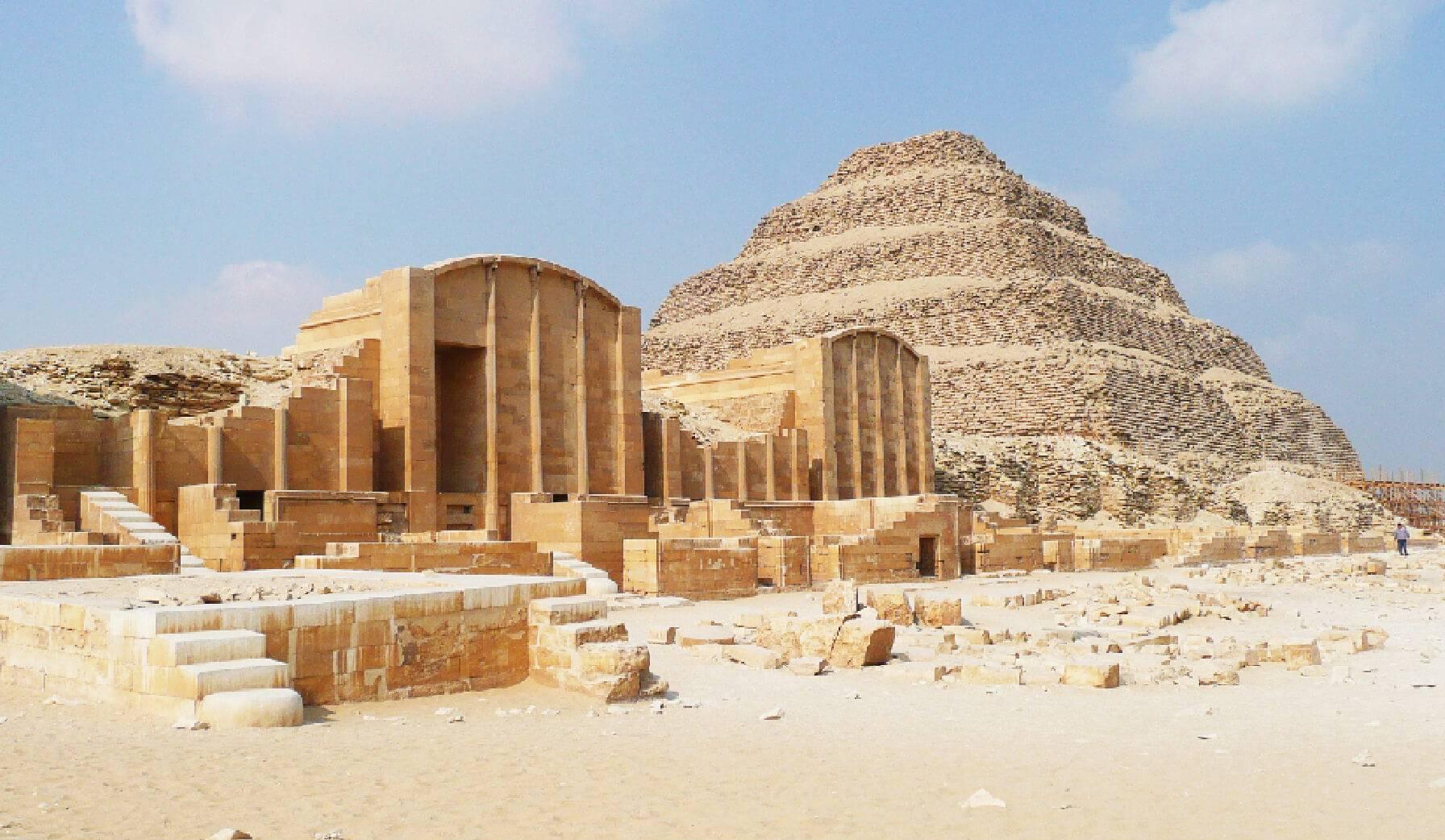
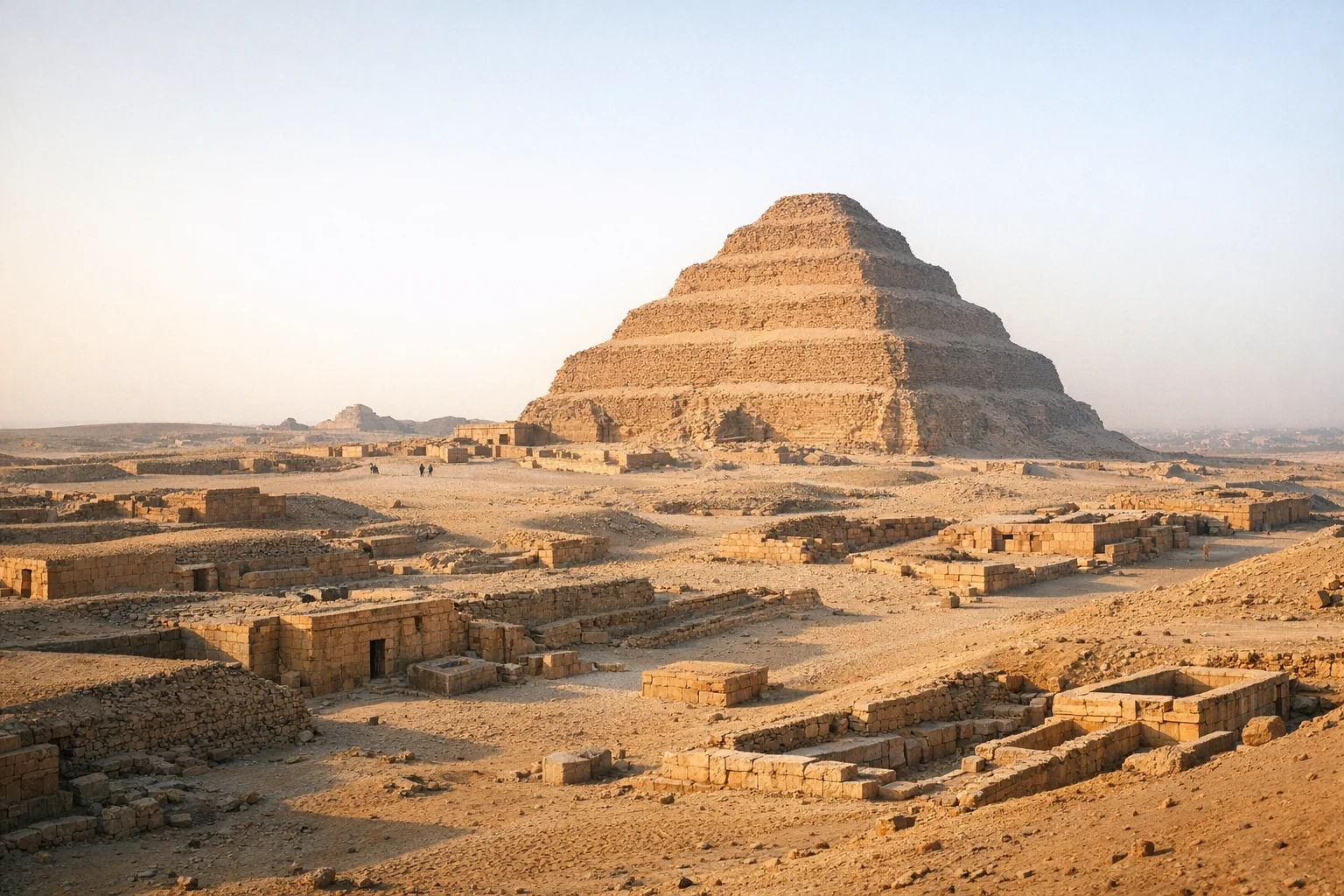
A six-tiered limestone structure built for Pharaoh Djoser around 2670 BC by his architect Imhotep, it stands as the oldest large-scale stone building known to have been constructed by humans. The pyramid's underground burial shaft, reopened to visitors after restoration, leads down to a massive granite sarcophagus chamber.
A roofed corridor lined with 40 engaged limestone columns carved to resemble bundled reeds, this colonnade is considered one of the oldest examples of stone columns in architectural history. It leads visitors from the outer wall into the great south court facing the pyramid.
The smallest pyramid of the Fifth Dynasty, dated to around 2350 BC, it holds the earliest known carved Pyramid Texts, funerary spells intended to guide the king's spirit into the afterlife. The narrow descending passage inside preserves faded blue-painted hieroglyphic inscriptions.
A network of underground galleries carved to hold the mummified remains of the sacred Apis bulls, each entombed in a granite sarcophagus weighing up to 70 tons. Rediscovered in 1850 by French Egyptologist Auguste Mariette, the tunnels stretch beneath the desert for hundreds of meters.
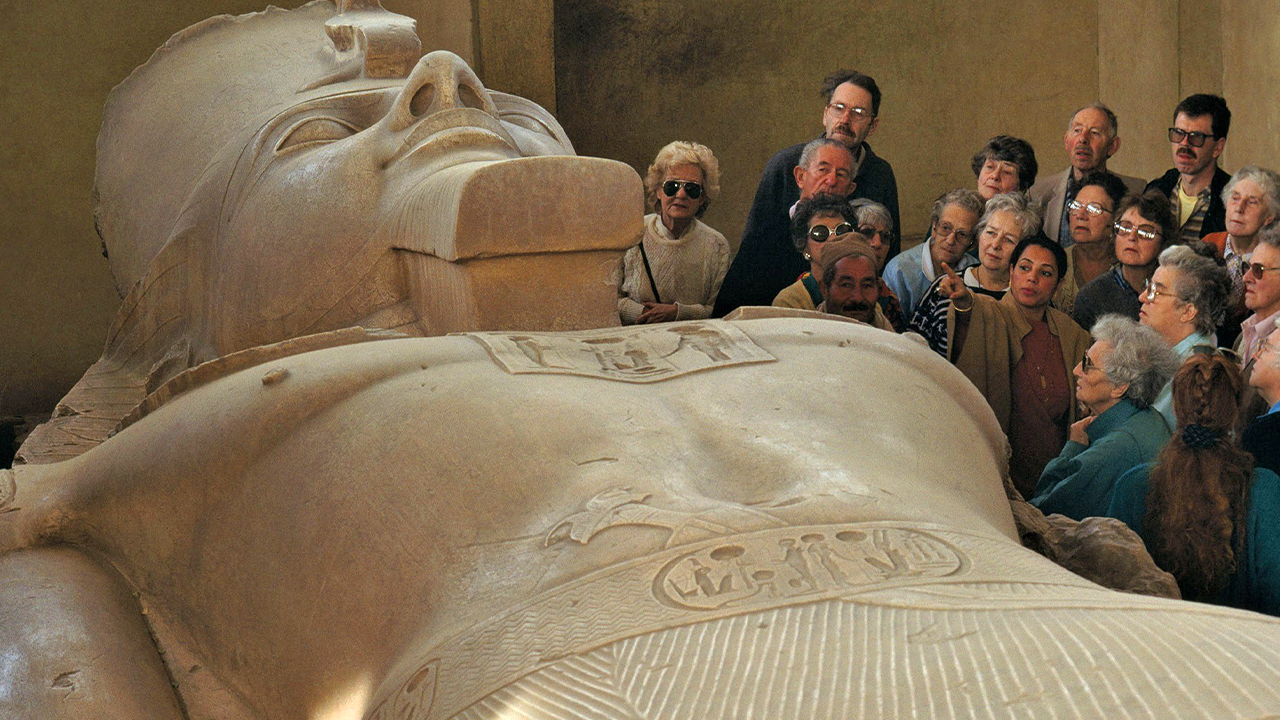
A fallen limestone statue of Ramesses II originally standing over 13 meters tall, now displayed lying on its back inside a purpose-built hall at the Memphis open-air museum. Discovered in 1820, the carved details remain sharp enough to make out the pharaoh's necklace and facial features up close.
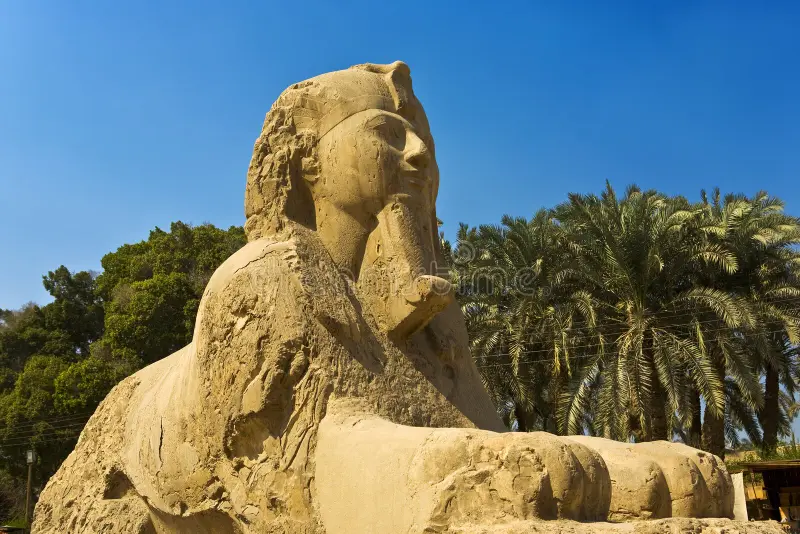
Carved from a single block of alabaster during the New Kingdom, this sphinx weighs an estimated 80 tons and originally guarded a temple dedicated to the god Ptah at Memphis. It remains one of the largest alabaster sculptures ever found in Egypt.
You reach the Saqqara plateau early, when the desert light is still flat and the Step Pyramid throws a long shadow across the entrance colonnade. You walk the ribbed limestone columns into Djoser's great courtyard, then cross toward the Pyramid of Unas, ducking into the burial chamber to read the star-blue ceiling and its incised spells. From there you descend into the Serapeum, where the temperature drops and the corridor opens onto granite sarcophagi taller than you are, each carved for a single sacred bull. You pause at the mastaba of Ti, tracing painted reliefs of boatmen and cattle that have kept their colour for four and a half thousand years. A saqqara and memphis tour usually gives you two to three hours across the necropolis before the midday heat arrives. Then you drive south to Memphis. You circle the fallen colossus of Ramesses II on its raised viewing platform, reading the cartouche on his belt, and step out to the alabaster sphinx in the garden beyond. You photograph scattered statuary under acacia trees, piecing together a capital that once stretched for miles. By the time you leave the ruins, you have crossed roughly a thousand years of Egyptian history in a single morning, and Giza still waits on the horizon.
All the details about your upcoming adventure in one place
A saqqara and memphis tour pairs the Step Pyramid of Djoser, the world's oldest stone monument, with the open-air ruins of Egypt's ancient capital and its colossal fallen statue of Ramesses II. Guided saqqara and memphis tour tours led by licensed Egyptologists move you through the Sakkara necropolis, painted mastaba tombs, and the alabaster sphinx while connecting each site to the broader Giza plateau story. It's a grounded, history-rich day out that suits first-time visitors and returning travelers alike.
The Step Pyramid of Djoser was the tallest structure on Earth when it rose around 2670 BCE, a stack of six mastabas engineered by Imhotep before the smooth-sided giants of Giza existed. That single decision — to pile stone in diminishing tiers rather than a low rectangular tomb — turned a royal cemetery into the birthplace of monumental architecture. A saqqara and memphis tour begins here, on ground that predates the Fourth Dynasty pyramids most visitors picture when they imagine Egypt. Saqqara served as the necropolis of Memphis, the capital founded at the junction of Upper and Lower Egypt and, for much of the third millennium BCE, the largest city in the world. Where Memphis governed the living, Saqqara held the dead across more than three thousand years of continuous burial, from First Dynasty nobles to Ptolemaic priests. The two sites are read together because one cannot be understood without the other: the city dictated the scale of the tombs, and the tombs are now nearly all that survives of the city. What remains is a landscape of layered ambition. The Djoser complex encloses a vast courtyard ringed by dummy chapels and a colonnade of ribbed limestone columns cut to imitate bundled reeds. Nearby, the Pyramid of Unas carries the earliest Pyramid Texts, hieroglyphic spells incised across its burial chamber walls. The Serapeum, a subterranean gallery of colossal granite sarcophagi, once housed the mummified Apis bulls sacred to Ptah. Painted mastabas such as those of Ti and Mereruka preserve reliefs of harvest, hunting and fishing in detail that still holds pigment. This density of monuments is why a Cairo Saqqara tour rewards slow attention rather than a single photograph. Memphis, a short drive south, now presents as an open-air museum around a recumbent colossus of Ramesses II and a calm alabaster sphinx, the scattered stone standing in for temples long quarried away. UNESCO inscribed the whole zone — Memphis and its necropolis from Giza to Dahshur — as World Heritage in 1979, recognising a corridor of funerary architecture unmatched anywhere. Ongoing excavation keeps the ground active; sealed shafts and painted coffins have surfaced here through the 2020s, and fresh discoveries still reshape the record. For travellers weighing Egypt landmarks against limited days, a saqqara and memphis tour offers the deepest chronological span of any single outing near Cairo. Well-run saqqara and memphis tour tours pair the archaeology with context, connecting Imhotep's experiment to the perfected geometry visitors later meet at Giza itself.
Where Memphis governed the living, Saqqara held the dead across more than three thousand years of continuous burial.
Egypt is a conservative country, so shoulders and knees should be covered for both men and women when visiting Saqqara and Memphis; lightweight, breathable fabrics work best given the open desert plateau. Sturdy closed-toe shoes are recommended for the sandy, uneven ground around the Step Pyramid of Djoser and the Memphis open-air grounds. A hat and sunglasses are strongly advised since there is minimal shade across the site.
A security checkpoint with bag scanning and a metal detector sits at the Saqqara entrance gate before ticket control, similar to checkpoints found across major Cairo Pyramids sites. Small daypacks and camera bags are permitted, but large suitcases or oversized backpacks should be left with the tour vehicle. Guards periodically inspect bags again near the Step Pyramid colonnade and at the Serapeum entrance.
Personal photography with handheld cameras and phones is included in the standard 600 EGP entry ticket at Saqqara and at the Memphis open-air museum. Tripods, professional rigs, and drone photography require a separate permit arranged in advance through the Ministry of Tourism and Antiquities. Flash photography is discouraged inside the Step Pyramid's underground burial shaft to protect the painted surfaces.
Children generally enjoy the open desert setting of Saqqara and the dramatic scale of the fallen Colossus of Ramesses II at Memphis, both of which invite exploration without museum-style crowd control. Strollers move easily across the Memphis grounds, though the sandy paths at Saqqara can be harder going for smaller wheels. Shade is scarce, so families should pace visits around the cooler 08:00–10:30 arrival window and bring extra water for children.
The Djoser complex's entrance colonnade and great south court are flat, gravel-paved, and passable for wheelchairs and strollers, and the Memphis open-air museum grounds are similarly level and stroller-friendly. However, the Step Pyramid interior, the mastaba tombs, and the Serapeum galleries all require descending steep stairs or ramps with no accessible alternative. Visitors with mobility needs should plan to view these interior chambers from the entrance only.
Bottled water and small snacks may be carried inside both the Saqqara and Memphis sites, since no on-site restaurant exists at either location. Food should not be consumed inside the Imhotep Museum galleries or near painted tomb reliefs to avoid contamination risk. Rubbish must be carried out or placed in bins near the entrance gates, as there is no food service within the archaeological zones themselves.
Slightly quieter midweek
Local visitor numbers rise afternoon
Busiest day for group tours
Hours
Daily 08:00–17:00, all week
Address
Saqqara Necropolis, Badrashin, Giza Governorate, Egypt
Access
Colonnade and south court are wheelchair-passable, pyramid interiors are not
Climate
Open desert plateau, little shade, hottest midday
Bag policy
Small bags allowed, screened at entrance checkpoint
Site scale
Necropolis stretches roughly 8 km north to south
Car · 60-75 min from central Cairo · Transfer often bundled in tour cost
Private car or hotel transfer from central Cairo takes the Cairo-Fayoum desert road south toward Badrashin; most Saqqara and Memphis tour operators include this transfer in the package price.
Taxi · 45-75 min depending on traffic · Roughly 300-500 EGP one way
A metered or app-based taxi from downtown Cairo or Giza can reach the Saqqara gate directly, though drivers may need the site name in Arabic for clarity.
Public transport · 90+ min with transfers · Low cost but time-consuming
No direct metro or bus line serves Saqqara or Memphis, so public transport requires a combination of microbus to Badrashin followed by a local taxi for the final stretch.
Bike · Not recommended · Not applicable
Cycling is not practical given desert road conditions and long distances between Cairo and the Saqqara plateau.
Most Saqqara and Memphis tour bookings can be cancelled for a full refund up to 24 hours before the scheduled pickup time. The Saqqara site entry fee of 600 EGP per foreign adult is non-refundable once a ticket has been issued at the gate.
Recommended time
3-5 hours
A thorough saqqara and memphis tour needs 3 to 5 hours total: roughly 2.5 to 3.5 hours across the Step Pyramid enclosure, the Serapeum, and two or three mastaba tombs, plus 45 minutes to an hour at the Memphis open-air museum. Arrive at opening to sequence the Step Pyramid and mastabas first, since queues and tour buses build steadily after 10:30, then drop underground into the cool Serapeum galleries once the surface heat peaks, saving Memphis for last as an easy, shaded finish. Trim toward 3 hours if skipping extra mastabas; add closer to 5 if a guide walks you through the Pyramid Texts and Imhotep Museum in depth.
Crowd levels through the day
Weather · crowds · average price — dots go green to amber to red as each metric rises.
Daytime temperatures stay in the mild high teens to low 20s Celsius, making this the most comfortable season for walking the open plateau at Saqqara. Tour groups peak around the winter holidays, so early gate arrival still helps avoid crowds.
Warm, dry weather with occasional khamsin dust winds in March makes April a popular but manageable month for a Saqqara and Memphis tour. School holiday crowds can build around the Easter period.
July and August bring daytime highs well above 35°C on the exposed desert plateau, so shade is scarce and hydration is essential. Visitor numbers thin out compared to winter, which suits travelers prioritizing fewer crowds over comfort.
Temperatures ease back toward the mid-20s to low 30s Celsius by November, restoring comfortable conditions similar to spring. This shoulder season sees moderate tour volumes without the winter holiday surge.
Egyptian pound notes in small denominations help with tipping site guards, museum attendants, and bathroom staff who commonly expect a few pounds at Saqqara and Memphis.
A licensed guide can explain the Pyramid Texts inside the Pyramid of Unas and the symbolism of the Djoser colonnade columns, details easy to miss without context.
Desert mornings can start cool even in summer before temperatures climb sharply by mid-morning across the open Saqqara plateau.
The Step Pyramid's underground burial shaft periodically closes for conservation work, so confirming access the day before avoids disappointment.
Since Dahshur sits only 10 km south of Saqqara, adding it to the same day makes efficient use of the desert transfer.
Saqqara ticket booths can have unreliable card connectivity, so having cash and a printed itinerary speeds up entry.
The underground galleries for the Apis bulls have uneven stone steps that can be slick after rare rain.
Saqqara Necropolis, Badrashin, Giza Governorate, Egypt
Ticket booths and security checkpoint sit just past the parking area
Get directionsMit Rahina, Badrashin, Giza Governorate, Egypt
Small entry building leads directly into the statue garden
Get directionsAround 2667 BC, the architect Imhotep raised a structure that had no precedent. For the pharaoh Djoser of the Third Dynasty, he built the Step Pyramid at Saqqara. It rose in six diminishing tiers to roughly sixty metres. Earlier royal tombs were low mud-brick mastabas. Imhotep stacked six mastabas of dressed limestone instead. The result was the world's first large-scale monument built entirely in cut stone. Any history threaded through a saqqara and memphis tour begins here, with a single genius who was later deified as a god of medicine and wisdom. The pyramid did not stand alone. Imhotep enclosed it within a vast walled complex of courtyards, chapels, and dummy buildings carved in stone to imitate reeds and timber. This funerary city served the necropolis of Memphis, the first capital of a unified Egypt, founded near the apex of the Nile Delta. For over a thousand years kings, nobles, and sacred animals were interred across these sands. The Serapeum, a subterranean gallery holding the granite sarcophagi of the Apis bulls, was cut beneath the plateau during the New Kingdom and expanded under later dynasties. Rediscovery came slowly. In 1851 Auguste Mariette, following a line of buried sphinxes, unearthed the lost Serapeum and its bull burials. In the 1920s and 1930s the architect Jean-Philippe Lauer began a restoration of Djoser's complex that occupied him for seventy years until his death in 2001. His painstaking reassembly gives the descriptive Saqqara necropolis tour its coherent form today. A well-planned saqqara and memphis tour tour now moves from this reconstructed enclosure toward Memphis and its toppled colossus of Ramesses II. Excavation continues. Since 2018 the Bubasteion cliffs and the shaft tombs near Djoser have yielded sealed coffins, gilded masks, and mummified cats, announced in seasons through 2020 and beyond. These finds keep the plateau in the news and swell demand for saqqara and memphis tour tickets. The Old Kingdom limestone, the Serapeum galleries, and Lauer's rebuilt colonnade all endure as the surviving core that most saqqara and memphis tour tours are built to reveal to a visitor standing before the oldest pyramid on earth.
Imhotep designs the Step Pyramid for Djoser as the first monumental stone building.
Subterranean Serapeum galleries are cut to entomb the sacred Apis bulls.
Auguste Mariette rediscovers the buried Serapeum and its granite sarcophagi.
Jean-Philippe Lauer begins his decades-long restoration of Djoser's complex.
Lauer dies after roughly seventy years reassembling the funerary enclosure.
Shaft tombs and the Bubasteion yield sealed coffins, gilded masks, and mummified cats.
Excavation seasons continue, sustaining fresh interest in the necropolis.
Forty engaged limestone columns line this roofed passage into the Djoser complex, framing a narrow strip of light at the far end. Stand at the eastern doorway and shoot straight down the corridor for a symmetrical, repeating-column composition. This is the classic opening shot many photographers use to plan a saqqara and memphis tour itinerary before heading further in.
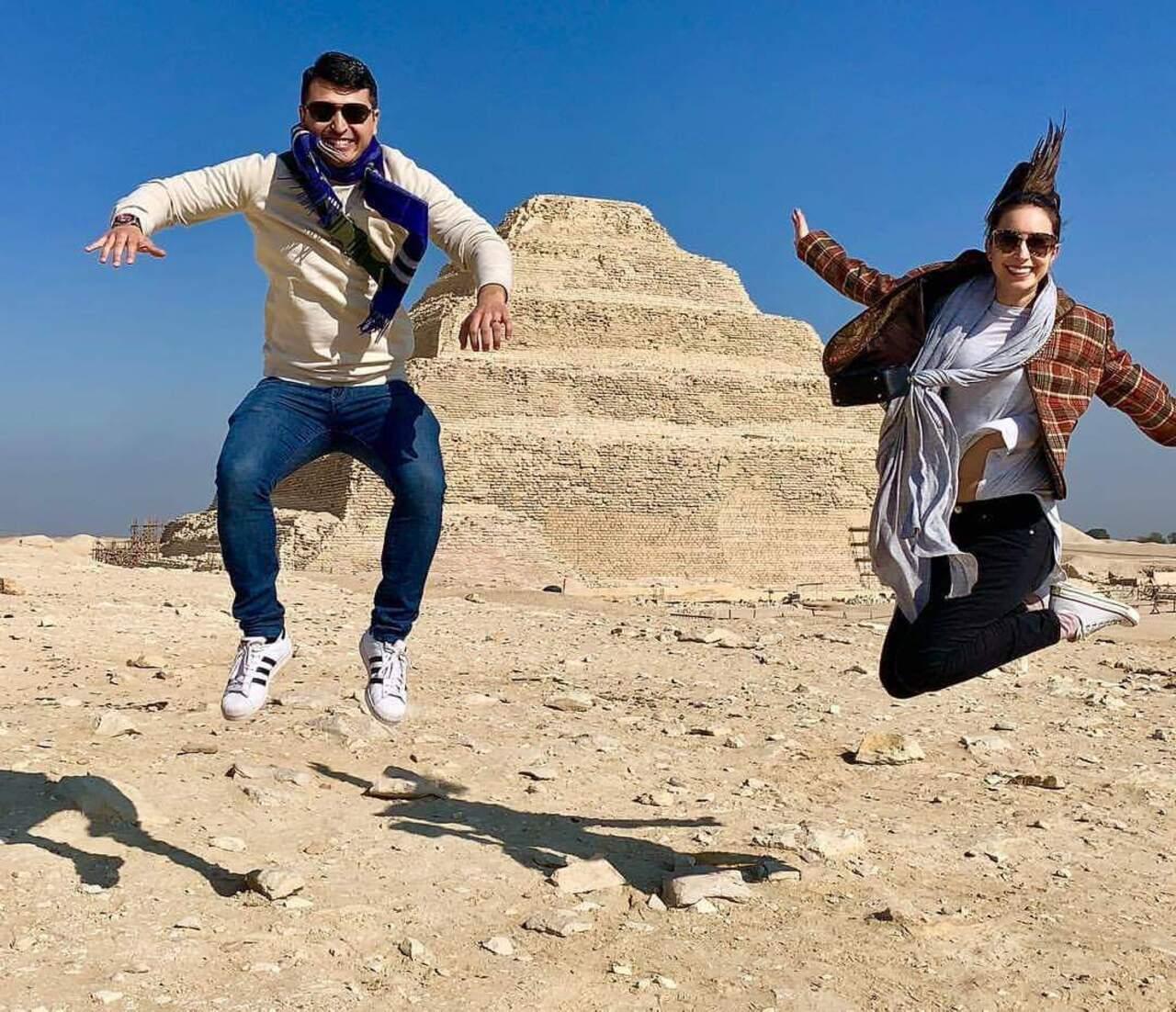
The open court beyond the colonnade lines up with the pyramid's six receding steps rising behind the dummy chapel facades. Position yourself at the court's south edge so the steps stack cleanly above the low chapel roofs. Wide-angle lenses capture both the ceremonial platform and the full pyramid height.
From the broad South Court, the Step Pyramid's western face catches warm side-light that carves out each of the six tiers in sharp relief. Stand near the court's southern boundary wall, well back from the pyramid base, to fit the whole structure with foreground sand texture. Skip-the-line Saqqara entry gets you into this court before tour buses fill it.
Inside the two-story pavilion at the Memphis open-air museum, an elevated walkway circles above the 10-meter reclining limestone colossus of Ramesses II. Shoot from the upper gallery corner for a full-length view, or crouch at floor level near the head for a portrait angle. Reflections off the hall's skylight can wash out midday shots.
Sections of the original palace-facade paneling survive near the entrance passage, showing the paneled niche pattern copied from early dynastic tomb walls. Get close with a mid-range lens to isolate the geometric relief against raking light. Useful as a texture or detail shot to pair with the wider colonnade frame.
Formal dining is thin at Saqqara itself, so most people visiting on a saqqara and memphis tour either eat at one guesthouse restaurant near the ticket gate, grab something quick in Badrashin village, or save the proper meal for Giza on the way back.
Garden courtyard setup run by a local family, known for home-cooked Egyptian plates like molokhia, stuffed pigeon and fresh bread; no signboard on the main road, so ask your driver or guide for directions. Best for a relaxed sit-down lunch after the Step Pyramid and Imhotep Museum, and quiet outside weekend tour-bus clusters.
Straightforward Egyptian rest-house fare (grilled chicken, rice, salads, tahini) aimed at coach groups passing between Saqqara and Memphis; fine for a fast, filling stop but service and menu choice are limited.
Simple stalls and small eateries in Badrashin selling foul, ta'mya (falafel) and feteer, useful for a cheap snack if you're touring independently rather than on an organized coach; not aimed at tourists, so expect basic seating.
All-day dining with pyramid views from the terrace, serving Egyptian, Indian and international dishes; many visitors book skip-the-line Giza pyramids tickets alongside a Saqqara and Memphis tour tour and stop here for breakfast or dinner rather than eating at the site.
Long-running Indian kitchen next to 139 Pavilion, popular for dinner after a full day covering Saqqara, Memphis and the Giza landmarks; reservations recommended since seating is limited and it draws both hotel guests and outside diners.
Real experiences from real travelers
We booked the saqqara and memphis tour to escape the Giza crowds and it worked. The Step Pyramid glowed orange around 8am and there were maybe a dozen people at the enclosure wall. Our guide pointed out the fluted columns of the Djoser complex that most people walk right past.
Standing over the reclining colossus of Ramesses II at Mit Rahina is something photos undersell — the thing is enormous and you view it from a gallery above. The Cairo Saqqara tour paced Memphis well before the midday heat built up. Bring water, the open-air section has almost no shade.
The saqqara and memphis tour covers a lot of ground so expect a full day of driving between the necropolis, Memphis, and back. The painted reliefs inside the mastaba of Kagemni were the highlight for me, the carved hippos and cattle still hold their color. One star off only because our lunch stop felt rushed.
Honestly the Saqqara necropolis tour impressed me more than the main Giza plateau. Climbing down into the Serapeum tunnels where the Apis bulls were buried was cool and dark, a nice break from the sun. The alabaster sphinx at Memphis is smaller than the Giza one but you can get right up close.
We added the skip-the-line Saqqara access and it saved us waiting at the Serapeum entrance where numbers are capped. Walking between those giant granite sarcophagi underground in the cool air was the strangest, quietest part of the trip. Wear proper shoes, the ramp down is uneven.
February morning, cold wind across the plateau, and the Pyramid of Unas causeway stretching out toward the Giza pyramids on the horizon. Our saqqara and memphis tour guide knew the tomb of Ti inside out and explained the daily-life scenes carved into the walls. Easily the most educational half-day we had in Egypt.
Manage expectations for Memphis — it is essentially an open-air museum with the Ramesses colossus and the alabaster sphinx rather than a grand ruined city. That said, the Cairo Memphis Saqqara excursion tied the history together and the drive through Mit Rahina palm groves was pretty. Saqqara itself is the real draw.
Booked the saqqara and memphis tour tickets as a private option and never regretted it. Having the mastaba tombs almost to ourselves at Saqqara, with dust motes hanging in the light from the entrance shafts, felt like stepping back five thousand years. The Egyptian landmarks here predate Giza and it shows in the older architecture.
Late afternoon sun turned the Step Pyramid terraces deep gold and the crowds had thinned. Our guide arranged a smooth saqqara and memphis tour tour that started early so we beat both the heat and the tour buses. The Imhotep Museum at the entrance is small but a good primer before you walk in.
What struck me on the saqqara and memphis tour tours was the range — the earliest step pyramid, later mastabas, the Serapeum, and then Memphis, all in one loop. Standing on the sand near the Unas pyramid you can see the Giza pyramids shimmering in the distance. A knowledgeable guide makes the difference between rubble and revelation here.
Everything you need to know for your journey
Saqqara is open daily from 08:00 to 17:00, seven days a week, with no weekly closure day, so a saqqara and memphis tour can run any day of the week.
The Djoser complex's entrance colonnade and south court are wheelchair-passable, but the pyramid interiors, mastaba tombs, and Serapeum galleries at Saqqara all involve stairs with no accessible route.
Prohibited items include unpermitted drones, tripods without a permit, professional video cameras without a permit, glass bottles, and weapons among others; a full list is provided in the visitor guidelines section.
Yes, personal photography with phones and handheld cameras is included in the standard Saqqara entrance fee, though tripods and drones require a separate permit.
Arriving between 08:00 and 10:30 offers cooler temperatures and fewer tour groups, making it the recommended window for a Saqqara and Memphis landmarks visit before midday heat sets in.
Shoulders and knees should be covered out of cultural respect, and sturdy closed-toe shoes are recommended for the sandy, uneven terrain across the Saqqara plateau.
Bottled water and small snacks are allowed on site, though food should not be consumed inside the Imhotep Museum or near painted tomb reliefs.
Most visitors reach Saqqara by private car or taxi from Cairo or Giza, a drive of roughly 45 to 75 minutes; no direct public transport line serves the site.
Yes, the open desert setting and the dramatic scale of the Colossus of Ramesses II at Memphis appeal to children, though shade is limited so hydration should be planned for.
Most saqqara and memphis tour bookings allow free cancellation up to 24 hours before pickup, though the 600 EGP Saqqara site entry fee itself is non-refundable once issued.
Dahshur Necropolis, home to the Bent and Red Pyramids, sits just 10 km south of Saqqara and is commonly added to a Cairo Pyramids, Saqqara and Memphis day tour.
Saqqara site entry costs 600 EGP for a foreign adult per person, the standard rate referenced across current Saqqara and Memphis tour tours.
Home to the Bent Pyramid and Red Pyramid, the earliest experiments in true pyramid construction under Pharaoh Sneferu. Far fewer visitors come here than to Giza or Saqqara.
A Fifth Dynasty tomb famous for its detailed painted reliefs of daily agricultural and hunting scenes. It sits a short walk north of the main Djoser complex.
A Sixth Dynasty pyramid with an accessible interior chamber inscribed with Pyramid Texts. It stands near the northern edge of the Saqqara plateau.
A large New Kingdom sphinx carved from a single block of alabaster, displayed in the open garden near the Colossus of Ramesses II.
A historic hotel at the foot of the Giza Plateau with pyramid views, popular with travelers combining Giza with a Saqqara and Memphis tour.
A modern resort-style property near Giza offering pyramid-facing rooms and a private pool.
A cluster of mid-range and budget hotels near the Giza Pyramids, convenient for early morning departures toward Saqqara.
Wide range of budget and mid-range hotels near central Cairo landmarks and transit links.
Join thousands of happy travelers who have discovered this incredible experience
Book Your Experience Now