English| EUR
Book Now
Open today · 07:00 – 17:00

Private Pyramids Tour

Private Pyramids Tour — Guided Entry Across the Giza Plateau

Limestone older than memory, dawn light before the crowds.

168K+ travelers chose this
Free Cancellation
Right now: Moderate — summer weekday Midday heat is intense in July; carry water and sun protection
4-6 hours recommended
1 Languages
Up to 6 guests
Free Cancellation
Free cancellation Instant confirmation Mobile voucher Verified partner Skip-the-line
146.6 m
Original height
Now ~138.5 m after erosion
c. 2560 BC
Built for Khufu
~4,600 years old
2.3M
Stone blocks
Avg. 2.5 tons each
230 m
Base length
Each side, near-perfect square
20 yrs
Construction time
Estimated build duration
700 EGP
Entry fee
Foreign adult, general area
Choose your ticket

Ticket options at a glance

Compare fares, pick the fit — all bookings are mobile-voucher and eligible for free cancellation where shown.

Private Giza Pyramids & Grand Egyptian Museum Explorer 7 hr
Luxury / Private

Private Giza Pyramids & Grand Egyptian Museum Explorer

4.7 (239)
€86
  • Private experience
  • Personal attention
  • Premium amenities
  • Free cancellation
Book this ticket
Private Giza Pyramids & Sphinx Half-Day Tour 4 hr
Luxury / Private

Private Giza Pyramids & Sphinx Half-Day Tour

4.9 (74)
€107
  • Private experience
  • Personal attention
  • Premium amenities
  • Free cancellation
Book this ticket
Compare options

Which ticket fits your trip?

A private pyramids tour starts with one core decision: general area entry alone, or general entry plus the separate interior-access add-on for the Great Pyramid. Both routes use the same 700 EGP foundation ticket, but only one lets you step inside Khufu's ancient chambers rather than just admiring the exterior.

General Area Entry Plateau, Sphinx & exteriors Top pick
General Entry + Interior Access Add-on for Khufu chamber
What it covers Giza plateau, Sphinx enclosure, all three pyramid exteriors
Where to buy Main ticket booths at plateau entrances
Typical add-on needed None required for plateau access
Access style Flexible, walk-in throughout opening hours
Availability Sold continuously during 07:00–17:00 hours
Best for Visitors focused on exteriors, photos and the Sphinx

Verdict: First-time visitors who want to actually enter the Great Pyramid should pair their private Giza landmarks itinerary with the interior add-on booked early, since a private pyramids tour guide can time the two separate ticket lines so neither slot is missed.

Is it worth it?

Worth it for first-time and context-hungry visitors

General area entry runs 700 EGP for a foreign adult, and a private pyramids tour layers a guide's fee on top of that. What you pay for is not access to the plateau, which the ticket already grants, but interpretation: someone who reads the Great Pyramid, the Sphinx, and the Giza necropolis aloud and answers what the stones cannot. Standing before the last surviving Wonder of the Ancient World is significant on its own, yet the causeways, mastabas, and limestone casing mean little without narration. A guided Giza pyramids tour also handles the hustlers and camel touts that wear down solo visitors. It pays off for first-timers, history readers, and anyone short on planning time. Independent travelers comfortable with self-guided landmarks can skip the guide and pocket the difference. Book reputable skip-the-line pyramids operators; private pyramids tour tours vary sharply in quality and price.

What makes it worth it

  • Guide decodes necropolis, Sphinx, and Great Pyramid
  • Buffer against camel touts and hustlers
  • Skip-the-line pyramids tickets save queuing time
  • No self-planning across the sprawling plateau
  • Custom pacing for a private pyramids tour tour

Keep in mind

  • Guide fee adds well above 700 EGP entry
  • Quality varies sharply between operators
  • Redundant for confident independent travelers
  • Some guides rush toward paid extras

Bottom line: For a first visit, a well-chosen private pyramids tour earns its cost; seasoned solo travelers can rely on general entry tickets alone.

Featured Experiences

Popular tours & activities

Hand-picked experiences loved by thousands of travelers

Recommended Experience

Powered by GetYourGuide

Another traveler favorite

Powered by GetYourGuide
Private Giza Pyramids Tour with Camel Trek & Lunch 4 hours Free Cancellation

Private Giza Pyramids Tour with Camel Trek & Lunch

Explore the Giza Plateau on a private excursion featuring a desert camel ride, historic insights, and authentic local dining.

4.7 (198)
FromFrom €49.96
See details
Private Giza Pyramids & Sphinx Tour with Lunch 4 hours Free Cancellation

Private Giza Pyramids & Sphinx Tour with Lunch

Experience the Giza Plateau on a private, stress-free journey featuring comfortable transport and a local meal.

5 (1)
FromFrom €77.1
See details
Private Giza Pyramids & Grand Egyptian Museum Tour 7 hours Free Cancellation

Private Giza Pyramids & Grand Egyptian Museum Tour

Discover Egypt’s historic marvels with an expert Egyptologist on this comprehensive private day tour.

4.9 (6)
FromFrom €55.99
See details
Your journey

Step-by-step — what your day looks like

1

Sphinx viewpoint

Start at the Sphinx enclosure for photos before crowds build up around mid-morning.

2

Great Pyramid exterior

Walk the base of the Pyramid of Khufu, the largest of the three main pyramids.

3

Panoramic desert viewpoint

Head to the elevated viewpoint southwest of the plateau for a wide shot of all three pyramids.

4

Khafre and Menkaure exteriors

Continue past the Pyramid of Khafre and the smaller Pyramid of Menkaure.

5

Valley Temple

Finish near the Valley Temple of Khafre close to the Sphinx.

What you'll see

Highlights not to miss

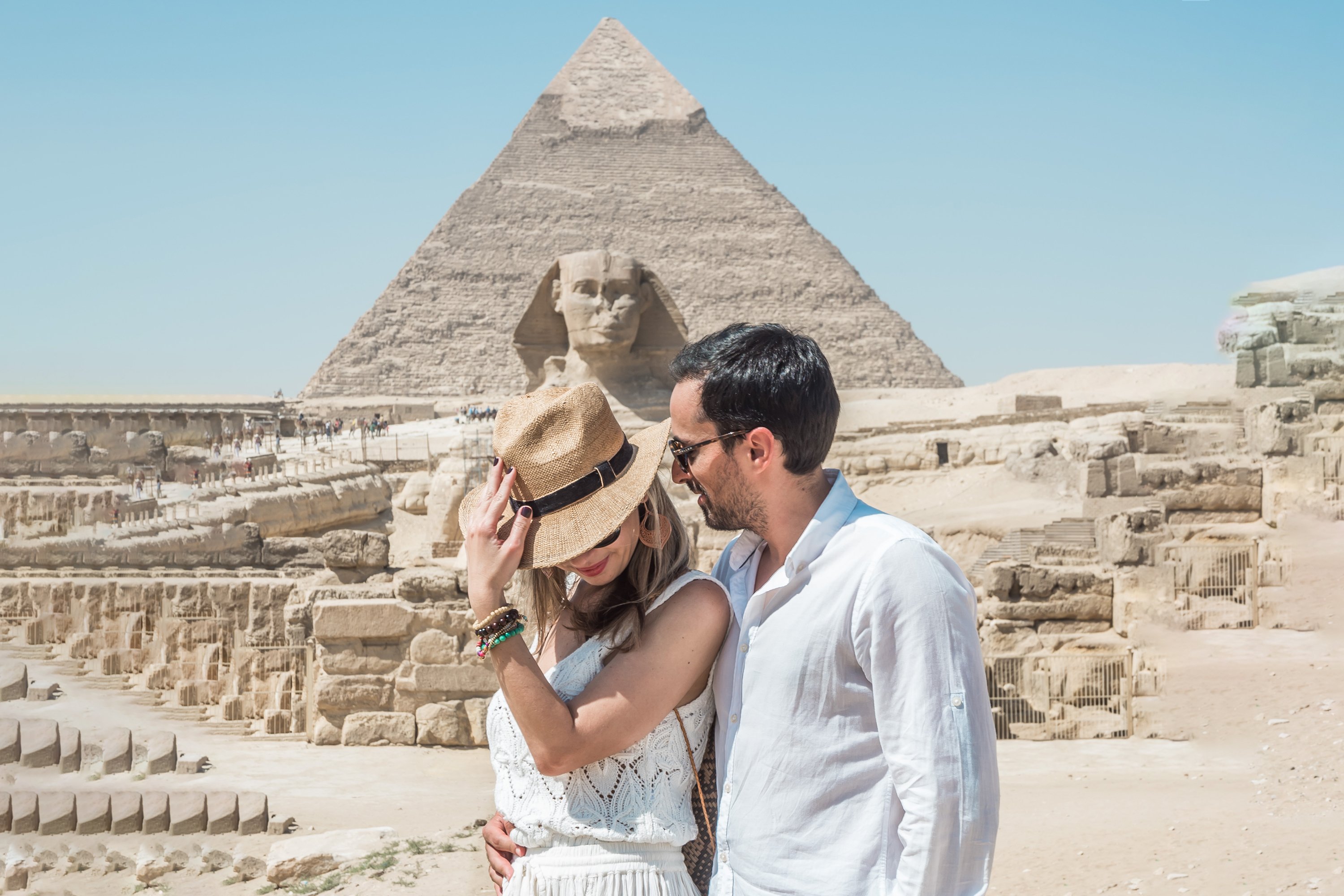
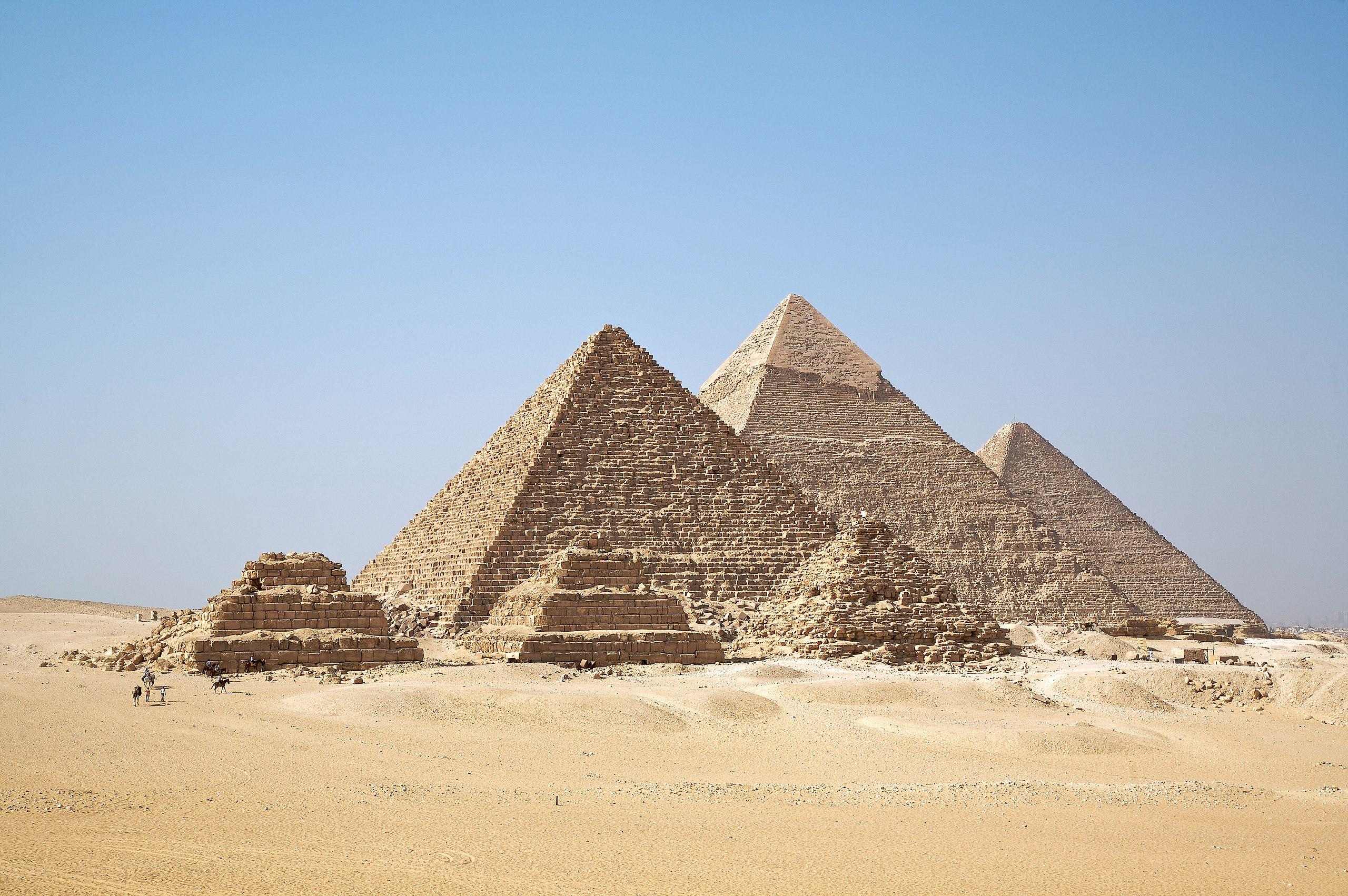
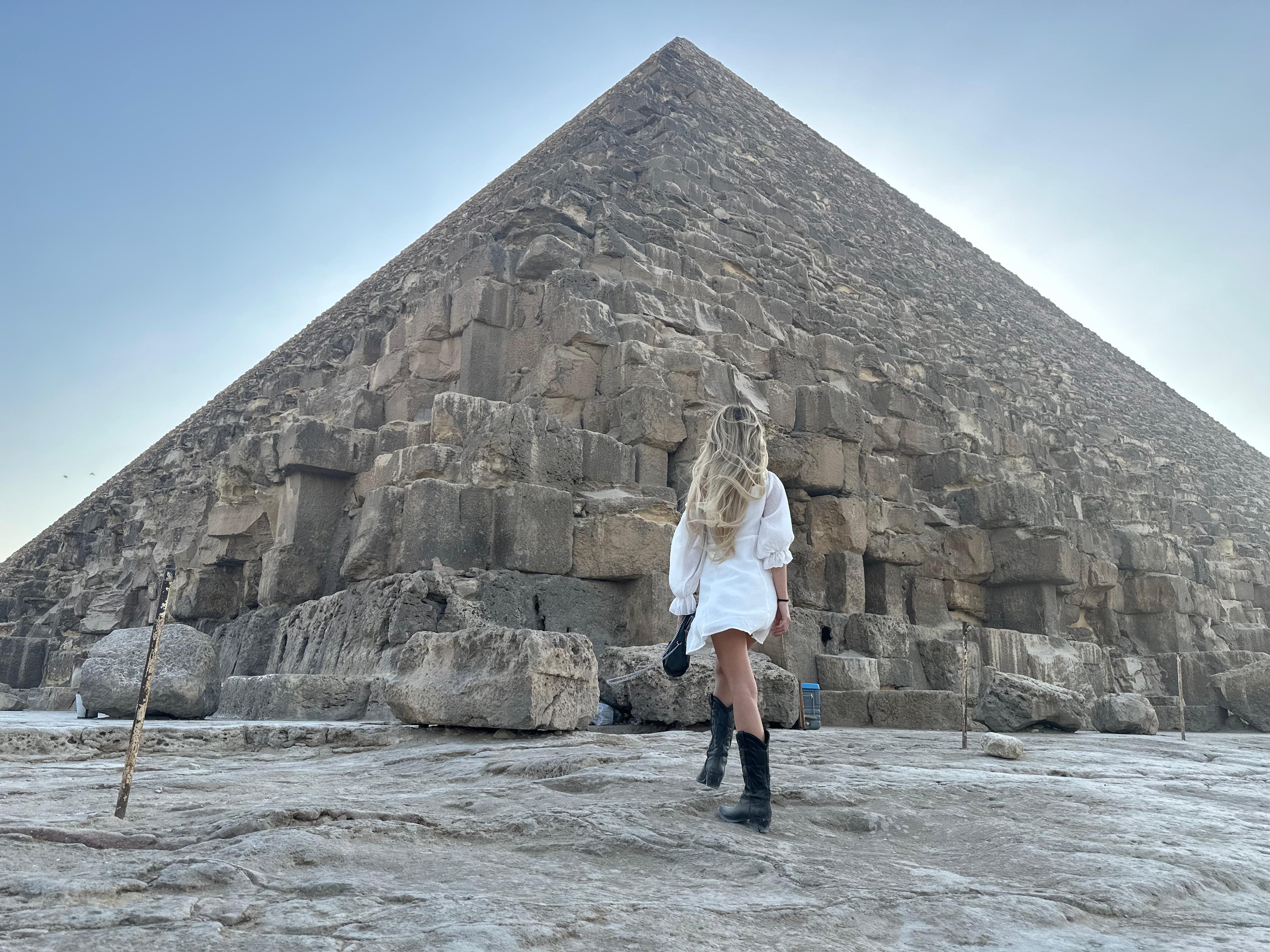
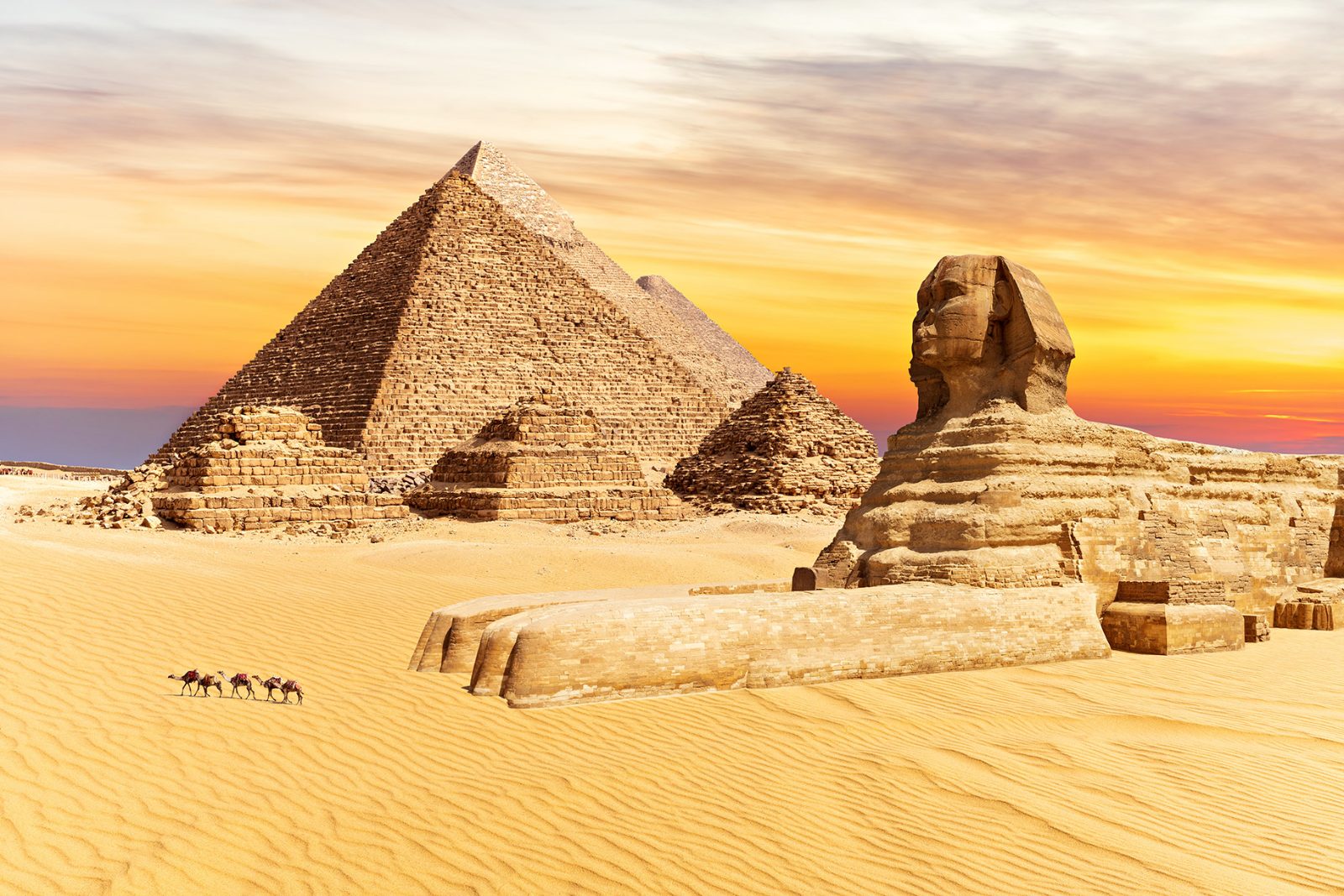
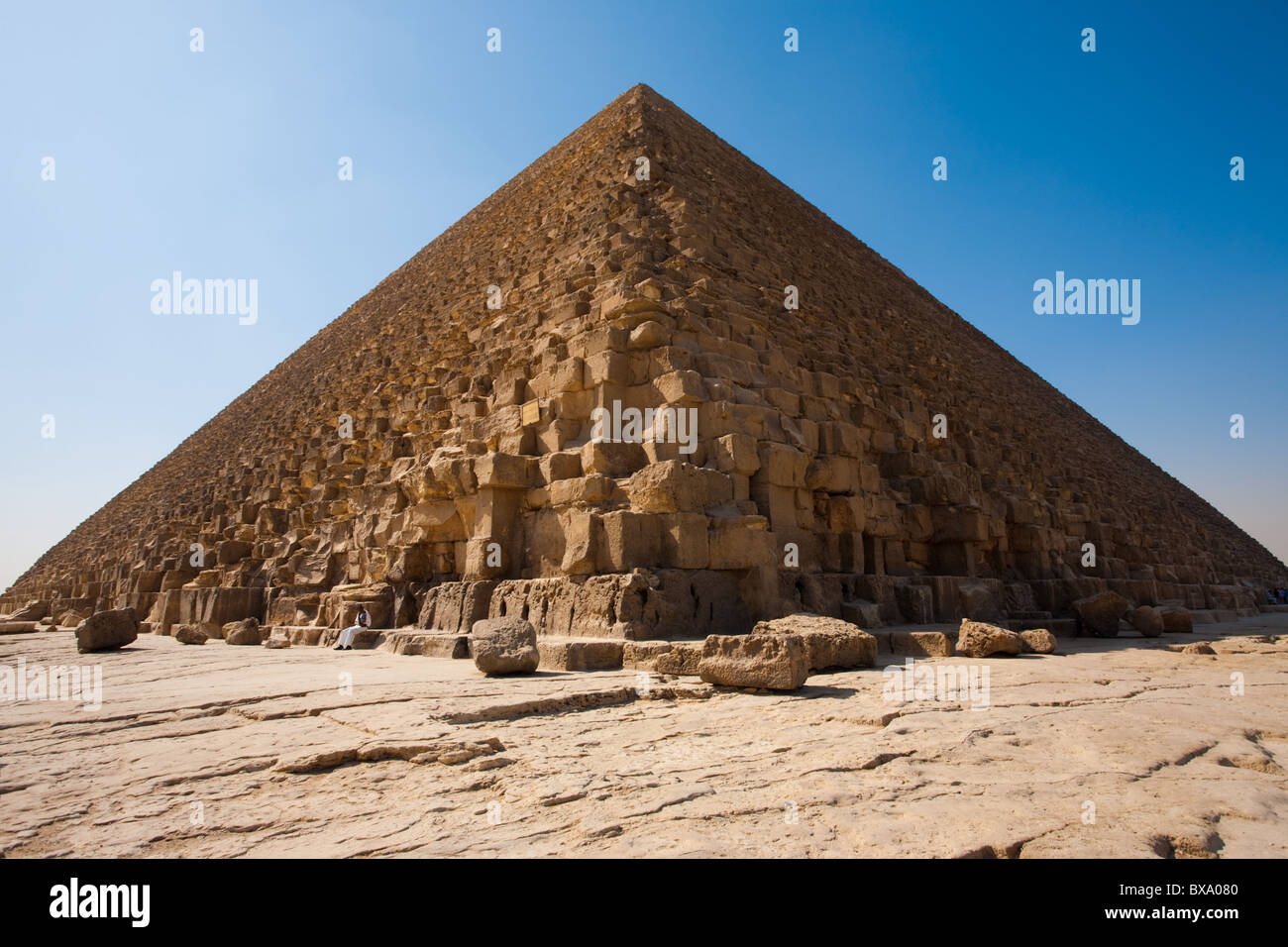
Great Pyramid of Khufu

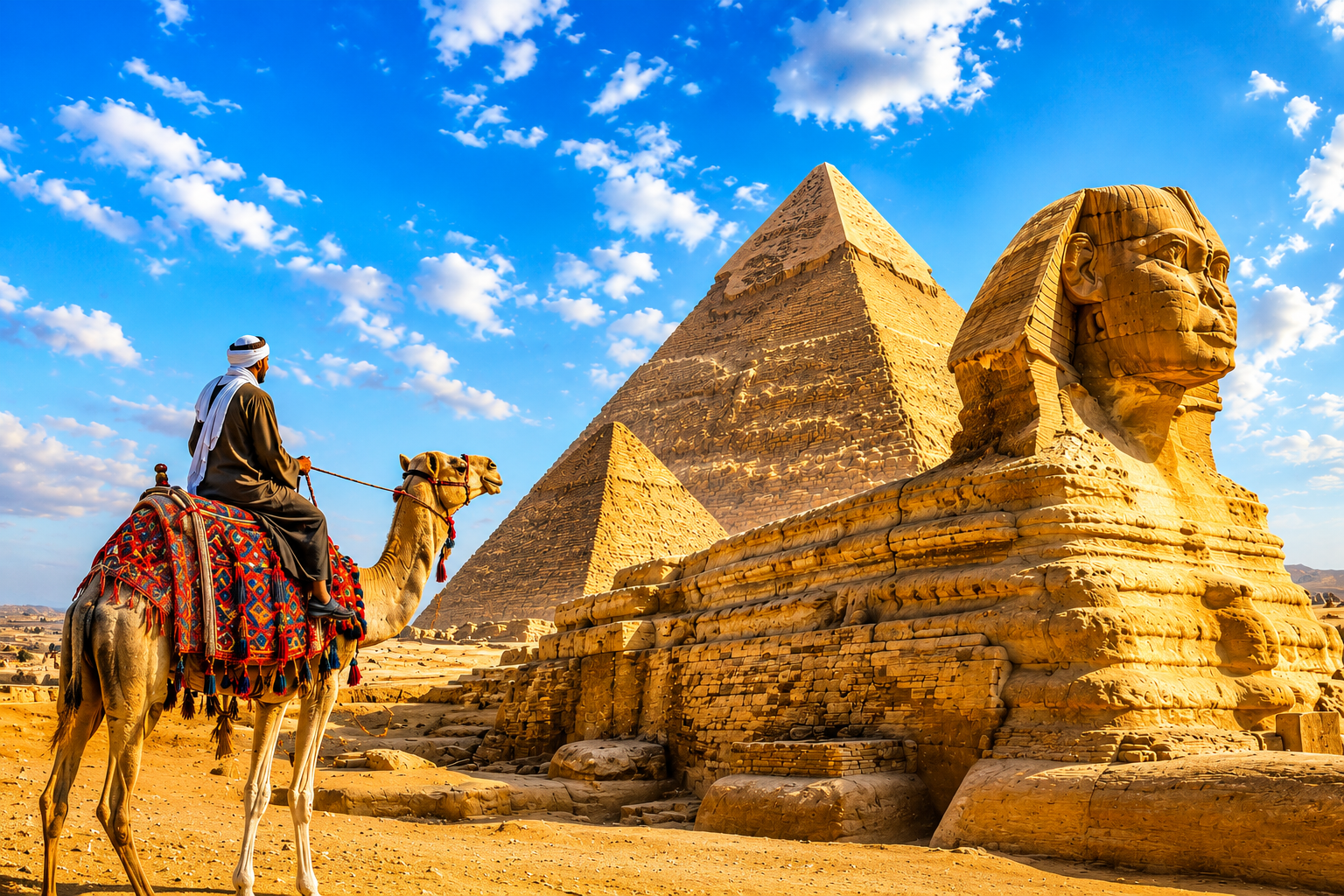
The largest of the three pyramids at Giza, originally standing 146.6 meters tall and built as the tomb of Pharaoh Khufu around 2560 BC. It remained the tallest man-made structure on Earth for roughly 3,800 years.

Pyramid of Khafre

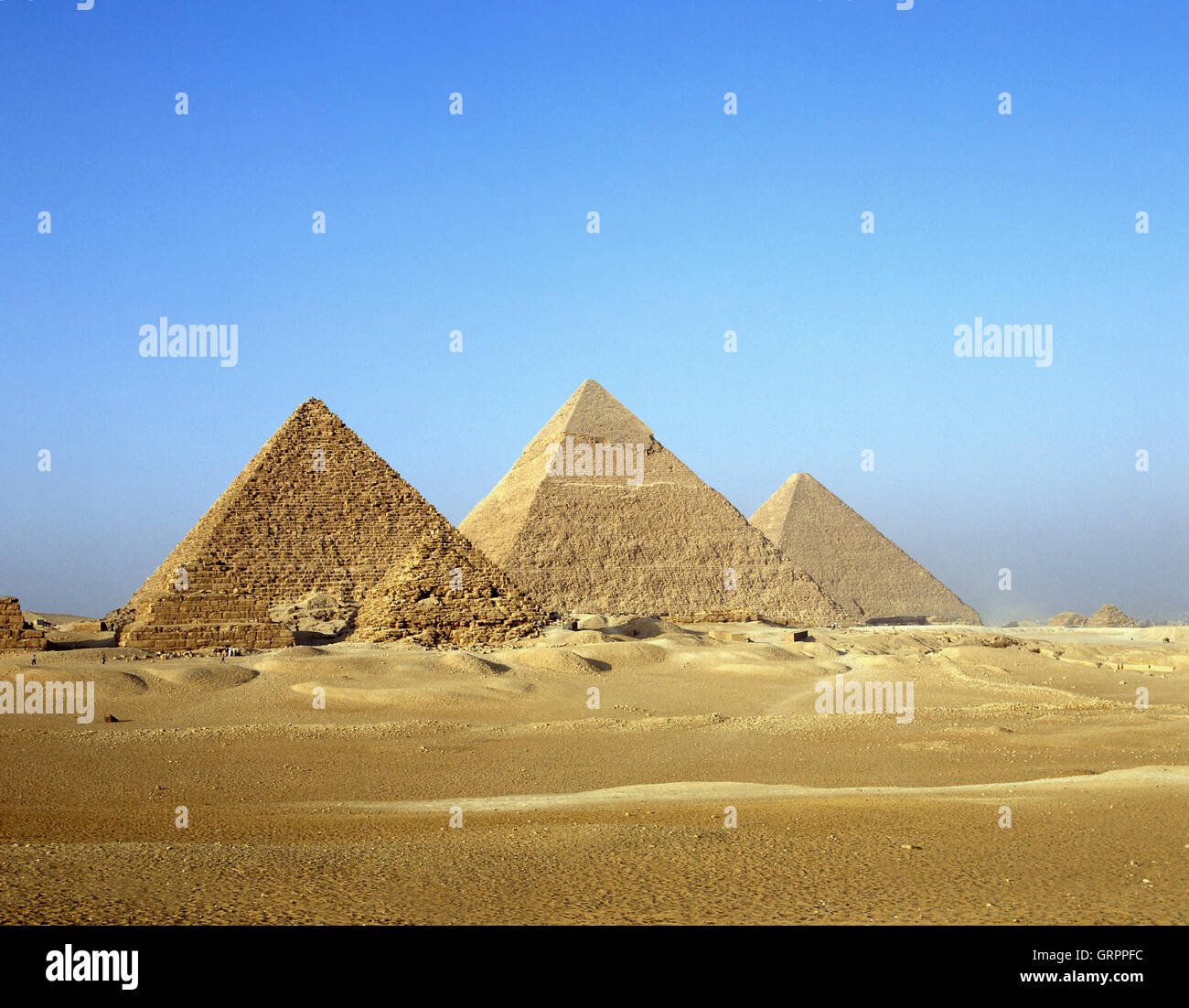
Built for Khufu's son Khafre, this pyramid retains a cap of smooth limestone casing near its summit, the only one of the three to still show original outer stone. It stands 136.4 meters tall, slightly shorter than Khufu's pyramid despite appearing larger due to its elevated bedrock foundation.

Great Sphinx of Giza

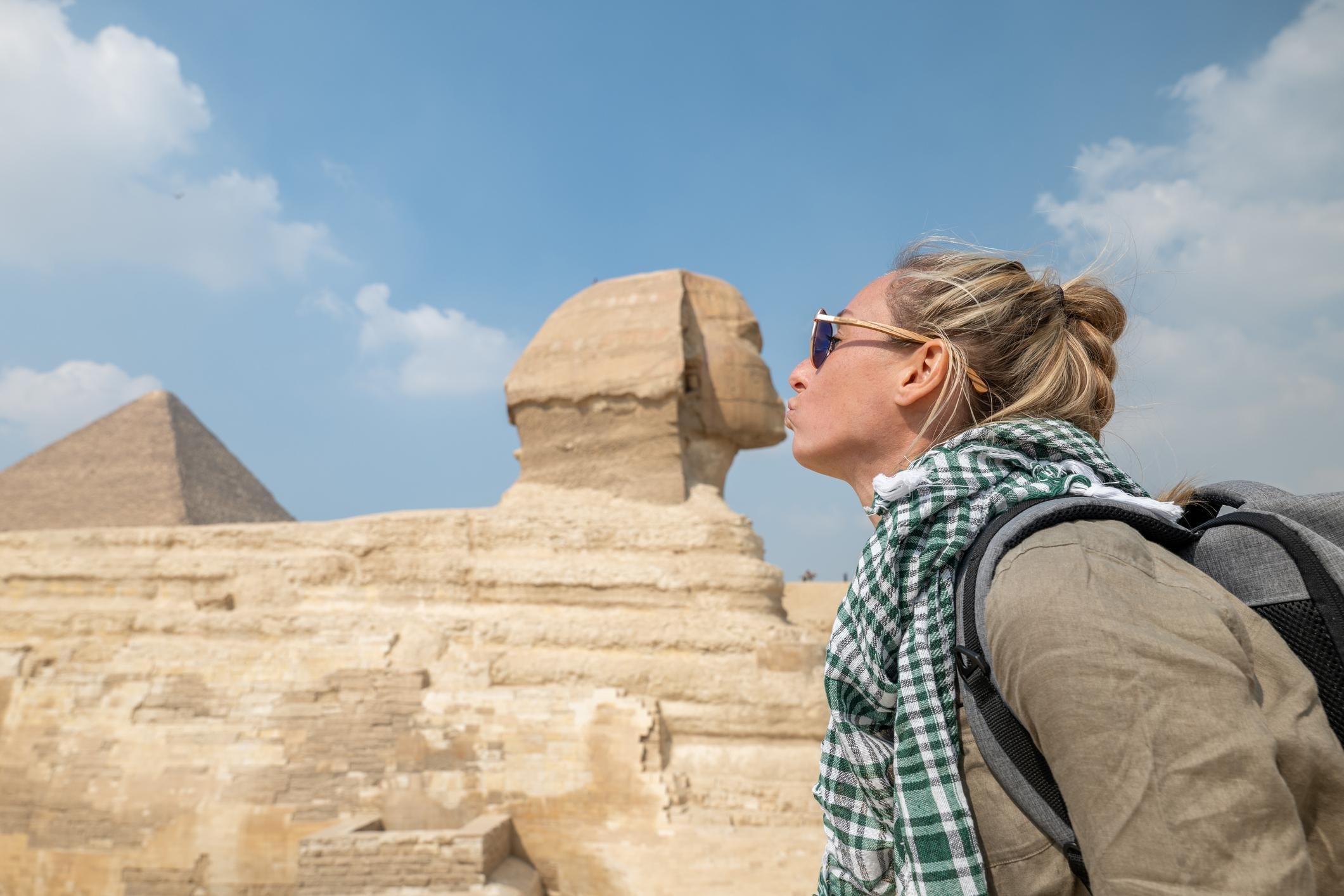
Carved from a single limestone outcrop, this recumbent lion with a human head measures about 73 meters long and 20 meters high. Its nose has been missing since at least the 15th century, with erosion and deliberate damage both cited as causes.

Pyramid of Menkaure

The smallest of the three main pyramids at 65 meters tall, built for Pharaoh Menkaure and notable for granite blocks used in its lower courses. Three smaller subsidiary pyramids sit beside it, believed to be for Menkaure's queens.

Solar Boat Museum

Home to a fully reconstructed 43-meter cedar wood funerary boat discovered disassembled in a pit beside the Great Pyramid in 1954. The vessel is believed to have been built for Khufu's journey into the afterlife.

Valley Temple of Khafre

Constructed from massive limestone blocks faced with pink granite, this temple sits just southeast of the Sphinx and was used in the mummification and burial rituals for Khafre. Its interior granite pillars remain remarkably intact after more than 4,500 years.

The experience

What the visit is really like

You arrive at the Al Haram gate as the light is still low and the stone reads amber rather than white. Your guide leads you first to the base of Khufu's pyramid, where you tilt your head back and lose the top edge against the sky. You run a hand across a single block taller than your waist, then step back to take in the full slope. You walk south along the plateau toward Khafre, pausing at the panorama point where all three pyramids line up in a receding row. You feel the desert wind pick up grit. A short ride or walk brings you to the Sphinx enclosure, where you stand level with its weathered paws and read the Dream Stele set between them. Midway through your private pyramids tour, you pause in the shade for water and a few unhurried minutes with the view. You watch camel drivers cross the sand below and photographers frame the necropolis from the ridge. On the ruins, distances feel deceptive, and your guide keeps the pace steady rather than rushed. You end near the eastern edge, looking back at the monuments you have just circled, the modern city of Giza pressing right up to the ancient boundary. You leave with sand on your shoes and the outline of Khufu still fixed behind your eyes.

Everything You Need to Know

Your complete experience guide

All the details about your upcoming adventure in one place

Your Private Pyramids Tour at Giza

A private pyramids tour brings you face to face with the Great Pyramid of Khufu, the Sphinx, and the ancient Giza Necropolis, guided by a dedicated Egyptologist who tailors the pace to your group. Our jولة الأهرامات الخاصة and skip-the-line Giza pyramids tours pair easily with a camel ride across the desert plateau, where the three main pyramids and their limestone causeways come into view. Private pyramids tour tickets keep your day flexible, with time for the panorama point and the surrounding Cairo landmarks.

The Great Pyramid of Khufu held the title of tallest human-made structure on Earth for roughly 3,800 years, until Lincoln Cathedral rose in England around 1311. It began near 146 metres; erosion and the loss of its outer casing have trimmed it to about 138 today. A well-run private pyramids tour begins with that scale, because scale is the first thing the plateau teaches. Three pyramids anchor the Giza necropolis: Khufu, Khafre, and the smaller Menkaure, built across the Fourth Dynasty roughly between 2600 and 2500 BC. Khafre's pyramid appears taller than Khufu's only because it stands on higher bedrock and still wears a cap of its original Tura limestone casing near the summit. Below it crouches the Great Sphinx, a single limestone outcrop carved into a recumbent lion with a human face, some 20 metres high and 73 metres long. The alignment of the monuments to the cardinal points is precise to within a fraction of a degree, an accuracy that continues to occupy engineers and Egyptologists alike. Why the site still matters is partly a question of survival. Of the Seven Wonders of the Ancient World catalogued by Greek writers, the Giza pyramids are the only one left standing, and they were already ancient when Herodotus described them in the fifth century BC. The plateau sits within a UNESCO World Heritage zone that also covers Saqqara and Dahshur, where the earlier step and bent pyramids record the experiments that made Giza possible. A thoughtful private Giza tour reads the plateau as a single evolving idea rather than three isolated tombs. The architecture rewards close attention. Khufu's pyramid contains an estimated 2.3 million limestone and granite blocks, some interior beams weighing more than 50 tonnes and quarried at Aswan, 800 kilometres south. Inside run the ascending and descending passages, the Grand Gallery with its corbelled walls, and the King's Chamber sheathed in red granite. Recent muon-imaging surveys have detected a large void above the Grand Gallery, a reminder that the structure still withholds answers. Many skip-the-line pyramids itineraries pair the monuments with the Grand Egyptian Museum nearby, where Khufu's reassembled cedar solar boat and the Tutankhamun collection extend the story indoors. Among the Cairo landmarks that draw travellers to Egypt, none compresses so much engineering, astronomy, and funerary belief into so few square kilometres, and a considered private pyramids tour leaves room for the plateau to speak for itself.

They were already ancient when Herodotus described them in the fifth century BC, and they are the last wonder still standing.

Dress code

Modest clothing is recommended for both men and women given the site's cultural setting and open desert exposure: shoulders and knees covered helps with sun protection as much as custom. Lightweight, breathable fabrics work best since there is little shade across the plateau, and closed-toe shoes are strongly advised for the loose sand and uneven stone blocks around the pyramids.

Bags & security

All visitors pass through a metal detector and bag scan at the main entrance gates on Al Haram Street before reaching the ticket checkpoint for the Giza Plateau. Backpacks and daypacks are permitted, but large suitcases or oversized bags are not allowed inside the perimeter and must stay with your driver or guide.

Photography

Photography and video with handheld cameras and phones are permitted across the open-air plateau, including the Sphinx enclosure and the exteriors of Khufu, Khafre, and Menkaure. Drone use is prohibited without a separate government permit, and tripods or professional rigs may require prior clearance from site officials.

Families & strollers

Children under 6 enter the Giza Plateau free of charge, making a private pyramids tour manageable for families with young kids. Strollers struggle on the sandy terrain, so a child carrier is more practical than a pushchair.

Accessibility

The area around the Sphinx has a paved viewing path suitable for wheelchairs, but most of the plateau surrounding the three pyramids is loose sand and uneven rock. Visitors with mobility limitations should arrange a vehicle that can drive closer to the main viewpoints, since walking distances between monuments exceed several hundred meters over unpaved ground.

Food & drink

No restaurants or cafés sit inside the ticketed plateau itself, though vendors near the entrance gates sell bottled water and snacks. Most private pyramids tour operators build a lunch stop at a nearby restaurant with pyramid views into the itinerary rather than dining on-site.

Not allowed

× Drones without a permit × Large suitcases × Tripods without clearance × Glass containers × Alcohol × Weapons or sharp objects × Flammable materials × Loudspeakers × Selfie sticks in certain restricted zones × Camping or overnight gear × Pets other than service animals × Professional filming equipment without a permit

What to bring

✓ Sunscreen ✓ Wide-brimmed hat ✓ Refillable water bottle ✓ Sunglasses ✓ Comfortable closed-toe shoes ✓ Cash in Egyptian pounds ✓ Valid ID or passport ✓ Portable phone charger

Opening hours

Mon 07:00 – 17:00
Tue 07:00 – 17:00

Quieter weekday morning

Wed 07:00 – 17:00
Thu 07:00 – 17:00
Fri 07:00 – 17:00

Later crowd due to prayer time

Sat 07:00 – 17:00

Busiest day of the week

Sun 07:00 – 17:00

At a glance

Hours

Daily 07:00–17:00, all week

Address

Al Haram, Nazlet El-Semman, Giza Governorate, Egypt

Accessibility

Paved paths near the Sphinx; uneven sand and stone across the plateau

Best Arrival

07:00–09:00 for cooler temperatures and smaller crowds

Bag Policy

Small bags permitted; security scan at entry gates

Getting there

Car · 20-30 min from Cairo · Moderate, depending on driver rates

Private cars and hotel transfers reach the Giza Plateau via the Cairo–Alexandria Desert Road or Al Haram Street from downtown Cairo in roughly 20–30 minutes depending on traffic.

Public transport · 45-60 min from central Cairo · Low cost

Cairo Metro Line 2 to Giza station, followed by a short taxi or microbus along Al Haram Street to the plateau entrance.

Taxi · 20-30 min from Cairo · Low to moderate cost

Ride-hailing apps like Uber and Careem operate reliably between Cairo neighborhoods and the Giza Plateau gates.

Bike · Not typical · N/A

Not commonly used given desert terrain and traffic along Al Haram Street; not recommended for most visitors.

Cancellation policy

Most private pyramids tour bookings allow free cancellation up to 24 hours before the scheduled start time, with a full refund issued to the original payment method. The Giza Plateau general area entry fee of 700 EGP per foreign adult is non-refundable once tickets are issued at the gate.

Plan your time

How long do you need?

Recommended time

2-3 hours

A private pyramids tour usually runs 2-3 hours, covering the main viewpoints, the Sphinx, and entry into one pyramid interior at an unhurried pace. Arriving inside the 07:00-09:00 window keeps this pacing loose, since guides can move freely between stops before tour buses fill the plateau. Add 45-60 minutes for a camel ride or extra time at the interior ticket queue, as capacity is limited and lines lengthen once large groups arrive. Skip-the-line arrangements help, but a private pyramids tour booked for first light still beats any queue-avoidance trick once mid-morning coach traffic sets in.

Crowd levels through the day

Early morning (07:00-08:00) Very light
Peak best window (08:00-09:00) Light
Tour bus arrival (09:00-11:00) Heavy
Midday (11:00-14:00) Heavy
Early afternoon (14:00-15:30) Moderate
Late afternoon (15:30-17:00) Light-moderate
Plan ahead

When to go — year at a glance

Weather · crowds · average price — dots go green to amber to red as each metric rises.

Winter (Dec–Feb)

Daytime temperatures stay in the mild teens to low 20s Celsius, making it the most comfortable season, though it is also peak tourist season with the largest crowds.

Spring (Mar–May)

Warm, dry weather with temperatures climbing into the high 20s and 30s Celsius; crowds thin out compared to winter but the khamsin winds can bring occasional sandstorms in March and April.

Summer (Jun–Aug)

Daytime heat regularly exceeds 35–40°C, so early morning arrival matters more than any other season; this is the quietest period for a private pyramids tour due to the heat keeping many travelers away.

Autumn (Sep–Nov)

Temperatures ease back into the high 20s and low 30s Celsius with moderate crowd levels, offering a balance between comfort and fewer tour groups.

Insider tips

Helpful tips for your visit

Book ahead for interior access

Great Pyramid interior tickets are limited daily and can sell out, so reserve online in advance if entering the chamber matters to your visit.

Bring small EGP bills

Cash in Egyptian pounds is useful for vendors and tips, even as card payment becomes more common at official counters.

Use a driver familiar with the plateau

A private pyramids tour with an experienced driver avoids confusion at the multiple entrance gates around Al Haram Street.

Watch for unofficial guides

Only use guides booked through a licensed operator; unofficial guides near the gates often charge inflated, undisclosed fees.

Confirm ticket categories at booking

Interior tickets for Khufu, Khafre, and Menkaure are sold separately from the 700 EGP general area entry, so confirm what's included before paying.

Carry a printed or digital ID

A passport or ID may be requested when purchasing student-discounted tickets or verifying nationality-based pricing.

Where to meet

Meeting points

Main Entrance Gate

Al Haram, Nazlet El-Semman, Giza Governorate, Egypt

Primary ticketed entrance on Al Haram Street; most private pyramids tour pickups start here

Get directions

Sphinx Entrance

Off Al Haram Street near the Sphinx enclosure

Secondary gate closer to the Sphinx, used by some guided groups

Get directions
The story

The history behind the site

The Giza plateau took its monumental shape during Egypt's Fourth Dynasty, roughly 2600 to 2500 BCE. Pharaoh Khufu began the work. His Great Pyramid rose around 2560 BCE. It reached about 146.6 metres, holding the record for tallest human structure for nearly four millennia. Its core swallowed some 2.3 million limestone blocks. The architect Hemiunu, Khufu's kinsman, is credited with overseeing the design. These monuments were royal tombs, not simple markers, engineered to protect a king's body and guide his passage to the afterlife. Khufu's son Khafre followed. His pyramid, built about 2570 BCE, looks taller because it stands on higher bedrock, yet it is slightly smaller. Khafre is also linked to the Great Sphinx that guards the causeway. Menkaure, likely Khafre's son, raised the third and smallest pyramid near 2510 BCE, sheathing its lower courses in red Aswan granite before the project was cut short by his death. A good private pyramids tour lingers over these family ties, because the plateau reads as one dynasty's ambition rendered in stone. Around each pyramid stood mortuary temples, causeways, and subsidiary tombs for queens and officials. The centuries were not kind. Medieval builders stripped the smooth Tura limestone casing to raise Cairo, leaving the stepped silhouette visitors see today. In the twelfth century, a Kurdish ruler's son attempted to dismantle Menkaure's pyramid; after months of labour the crew abandoned the effort, having barely scarred it. Napoleon's 1798 expedition brought the first systematic survey, and scholars later measured the structures with growing precision. Of the classical Seven Wonders of the Ancient World, the Giza pyramids alone survive, a fact any private pyramids tour tour will underline. That endurance is why the site anchors so many Giza landmarks itineraries and why guides framing skip-the-line pyramids access still return to the raw chronology. Modern stewardship arrived slowly. UNESCO inscribed the Memphis necropolis, including Giza, as a World Heritage Site in 1979. Ongoing excavation has uncovered the workers' village, correcting the old myth of slave labour and revealing a paid, fed, and organised workforce. Booking private pyramids tour tickets today buys entry to a landscape still yielding discoveries. Reputable private pyramids tour tours weave these threads together, turning weathered stone into a legible record of the people who quarried, hauled, and dressed it.

c.2560 BCE

Khufu completes the Great Pyramid, tallest structure on earth for nearly 3,800 years.

c.2570 BCE

Khafre raises the second pyramid and is linked to the Great Sphinx guarding its causeway.

c.2510 BCE

Menkaure builds the smallest pyramid, its lower courses cased in red Aswan granite.

12th c.

A ruler's son tries and fails to dismantle Menkaure's pyramid, leaving only a gash.

1798

Napoleon's expedition conducts the first systematic survey of the plateau.

1979

UNESCO inscribes the Memphis necropolis, including Giza, as a World Heritage Site.

1990s

Excavation of the workers' village reveals a paid, organised labour force, ending the slave myth.

Photo spots

Best photo spots

Panoramic Viewpoint

Best light · Sunrise or just before sunset

The desert plateau southwest of the main complex is the only place where Khufu, Khafre, and Menkaure line up in one unobstructed frame against open sand. Guides on a private pyramids tour usually drive or walk you here along the paved road past the parking area, then push a short way into the dunes for a cleaner angle with fewer people in the shot.

Sphinx Viewing Platform

Best light · Late afternoon, before closing

The elevated platform beside the Great Sphinx lines up the statue's profile with the pyramids behind it, and it's the spot for the classic forced-perspective shot of kissing the Sphinx. Stand on the eastern side, angle low, and wait for a gap in the crowd near the railing.

9 Pyramids Lounge Terrace

Best light · Midday for lunch light, or golden hour

This open-air terrace sits out in the dunes south of the pyramids and looks across at all nine structures, including the smaller queens' pyramids, for a wider desert composition than shots taken near the entrance. It works well paired with a meal stop, since seating faces the view directly.

Helicopter Pad Viewpoint

Best light · Early morning, before 09:00

A quieter alternative just past the Panoramic Viewpoint, this small rise gives a slightly different alignment of the three pyramids with almost no other visitors around. It's an easy stop on foot along the same route.

Western Desert Ridge

Best light · Sunset

Walking further west of the plateau into open desert produces a layered, stacked silhouette of the three pyramids as they recede in size, a favorite angle for wide landscape shots. Bring water and sun protection, since there's no shade on the walk out.

Gallery

Moments from the experience

With kids

Visiting with kids

A private pyramids tour works well for families because a driver and guide can pace the visit around the plateau's heat and size rather than sticking to a fixed group schedule. The terrain is sandy and uneven, so this is a hands-on visit, not a stroller-friendly landmarks tour.

Strollers

Leave the stroller at the hotel: the plateau's sand and rock make wheels impractical, and a carrier works far better for babies and toddlers. Restrooms exist near the Khufu ticket booth and the Solar Boat Museum, but they're not stroller stops anyway.

Best ages

Kids around 6 and up handle the walking and heat best, while under-3s do fine if carried rather than expected to walk. A private guide can shorten the route on the fly if a younger child tires early.

Pacing

Plan short bursts between shade breaks rather than one long loop, since there's little natural cover across the plateau. A private driver can reposition the car near each viewpoint so kids aren't marched between sites on foot.

Vendors

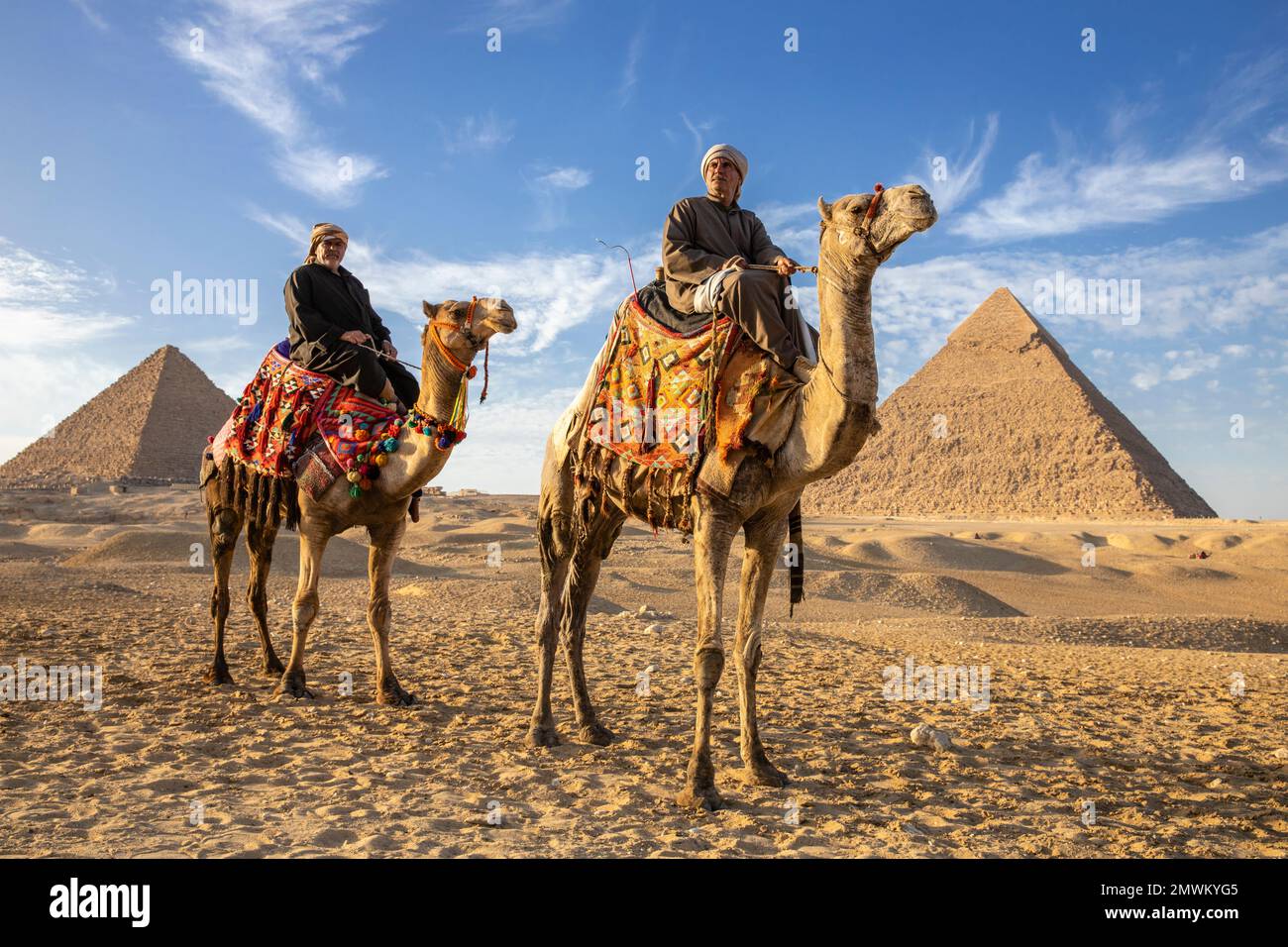
Camel and horse touts approach quickly near the parking area, and kids can find the pressure overwhelming. A private guide runs interference, setting expectations upfront and stepping in so parents aren't negotiating while managing children.

Facilities

Two paid restrooms serve the site, near the Khufu ticket booth and the Solar Boat Museum gift shop, so factor in a small coin for entry. There's no dedicated baby-change room, so a portable mat is worth packing.

Family tickets

There's no discounted family bundle; entrance runs 700 EGP per foreign adult, so a private pyramids tours provider can advise separately on child pricing and any combined ticket options.

Customer Reviews

What travelers say

Real experiences from real travelers

4.4
Based on undefined reviews
1 ★ 1100
2 ★ 732
3 ★ 1300
4 ★ 3900
5 ★ 14300
M
Marta L.
Spain · 2026-06-18

Guide made the difference

Our private pyramids tour started early before the heat became too much, and having a knowledgeable Egyptologist to ourselves meant we could linger at the Sphinx without being rushed. The scale of the Khufu blocks up close is hard to describe until you stand beside them.

J
James R.
United States · 2026-05-30

Worth the early start

We were on the plateau by sunrise and the light on the limestone was soft and warm. Our guide handled the entry logistics so smoothly that the skip-the-line pyramids access felt effortless.

H
Hiroshi T.
Japan · 2026-07-02

Hot but rewarding

July on the Giza plateau is genuinely hot, so bring water and a hat. The camel ride between viewpoints was a highlight and the guide framed some great photos of the three pyramids in a row.

A
Amelie D.
France · 2026-04-12

Just us and the desert

Booking a Giza pyramids tour privately meant we set our own pace and asked endless questions about Khafre and Menkaure. Standing inside the burial chamber was quieter than I expected in the low afternoon light.

C
Carlos M.
Brazil · 2026-03-08

Smooth from start to finish

The driver picked us up from our Cairo hotel and the whole day flowed without stress. A private pyramids tour tour like this is the way to see the plateau if you dislike big coach groups.

S
Sophie K.
Germany · 2026-02-15

Sunrise over Khufu

We watched the sun climb over the Great Pyramid with almost no one else around. Our guide knew exactly where to stand for the panorama of all three pyramids and the valley temple below.

D
Daniel O.
United Kingdom · 2025-11-22

Good value private day

The private pyramids tour tickets covered entry and a knowledgeable guide, and we appreciated not being herded. Wind kicked up sand in the afternoon so wrap a scarf around your camera.

P
Priya N.
India · 2026-01-19

Egyptology made real

Having the plateau explained by someone fluent in the history of these Cairo landmarks brought the whole site alive. The Sphinx enclosure at golden hour was calm and the shadows across the causeway were beautiful.

L
Lucas F.
Australia · 2025-09-14

No rush, no crowds

What sold us on the private pyramids tour was the freedom to stay longer wherever we wanted. We ended at the panorama point as the light turned amber and the desert cooled.

E
Elena V.
Italy · 2026-06-27

Personal and unhurried

A rehlat al ahramat privately arranged meant our guide tailored the route to what we cared about most. Comparing the smooth casing remnants near the top of Khafre to the rougher core blocks was fascinating up close.

FAQ

Frequently asked questions

Everything you need to know for your journey

Around the corner

Nearby landmarks worth a detour

Solar Boat Museum

5 min walk

museum

Houses a reconstructed cedar wood funerary boat found buried beside the Great Pyramid of Khufu. The vessel dates to around 2500 BC and was excavated in pieces in 1954.

Giza Plateau panoramic viewpoint

10 min drive

viewpoint

An elevated desert lookout point southwest of the pyramids offering a wide-angle view of all three main structures together.

Nazlet El-Semman village

10 min walk

square

A local village adjacent to the plateau with shops, cafés, and papyrus workshops catering to visitors.

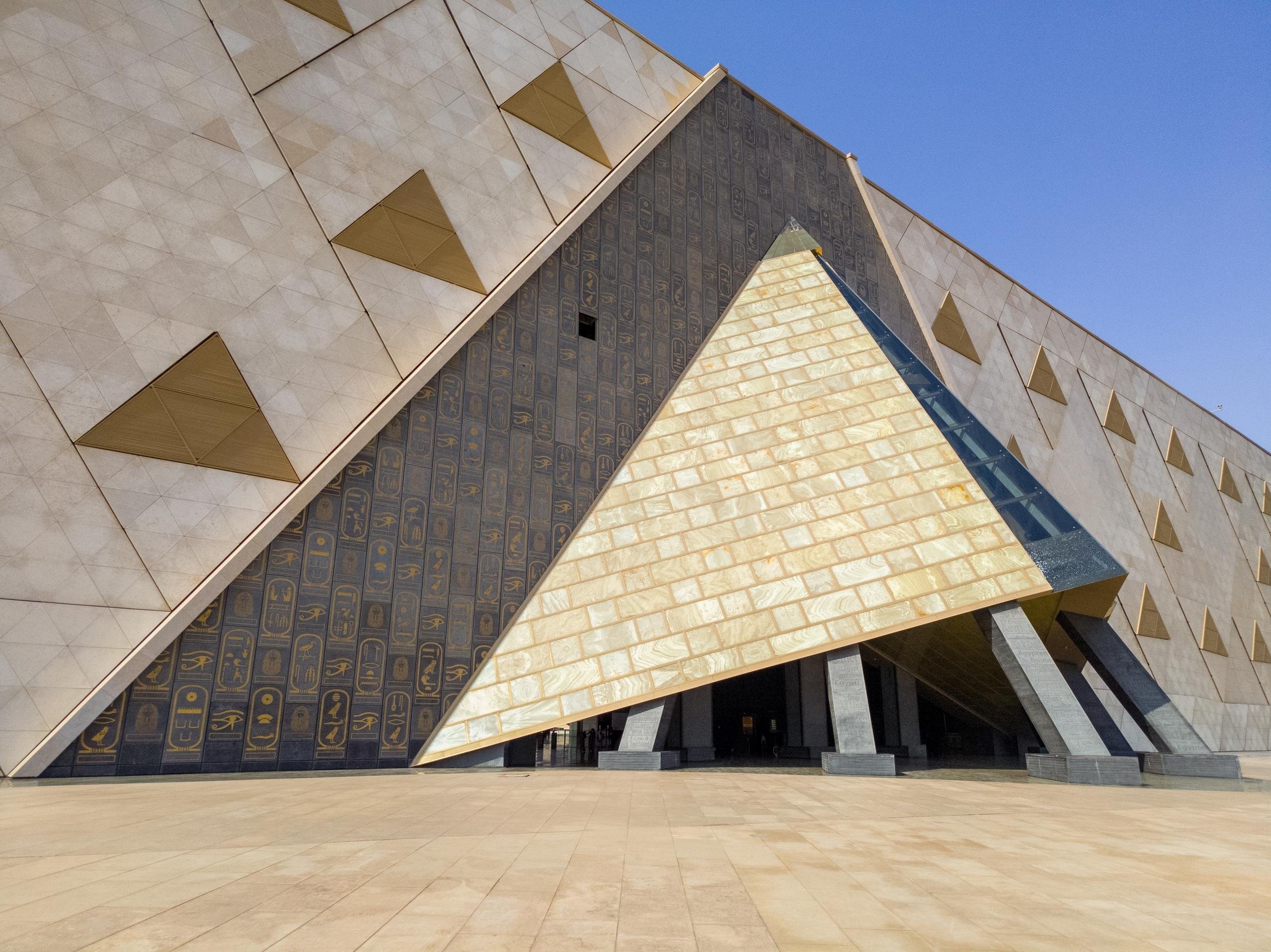
Grand Egyptian Museum

15 min drive

museum

A large new museum near the plateau housing artifacts from across ancient Egyptian history, including material from Tutankhamun's tomb.

Where to stay

Where to stay nearby

Marriott Mena House, Cairo

5 min walk

luxury

A historic hotel directly adjacent to the Giza Plateau with pyramid views from its gardens and many rooms.

Giza Al Haram district

walking distance

district

A cluster of mid-range and budget hotels along Al Haram Street within a few minutes of the entrance gates.

Cairo downtown hotels

20-30 min drive

mid-range

A wider range of mid-range hotel options in central Cairo, a short drive from the plateau.

Ready for Adventure?

Join thousands of happy travelers who have discovered this incredible experience

Book Your Experience Now